Free webinar: Revisiting community wind through the lens of community solar

Decarbonizing the electricity sector will likely require a broad portfolio of clean energy technologies and development approaches. “Community renewables” has proven to be a popular development model that promises to broaden public support for renewable generation, but at present is largely limited to a single technology: solar. New research from Berkeley Lab seeks to leverage the success of community solar by exploring how some of its central tenets could be applied to help reinvigorate the community wind market.
Back in the 2000s, community wind—a development model that was based largely on community ownership—was a vibrant and up-and-coming sector of the utility-scale wind market in the United States. By the early 2010s, however, community wind had largely faded from view in the United States, soon to be replaced by community solar, which introduced a different type of development model based primarily on subscription or “community offtake” rather than ownership (the figure below provides a stylized comparison of both models). Today, the community solar market continues to thrive and expand, and is considered one of the most dynamic sectors of the U.S. solar market.
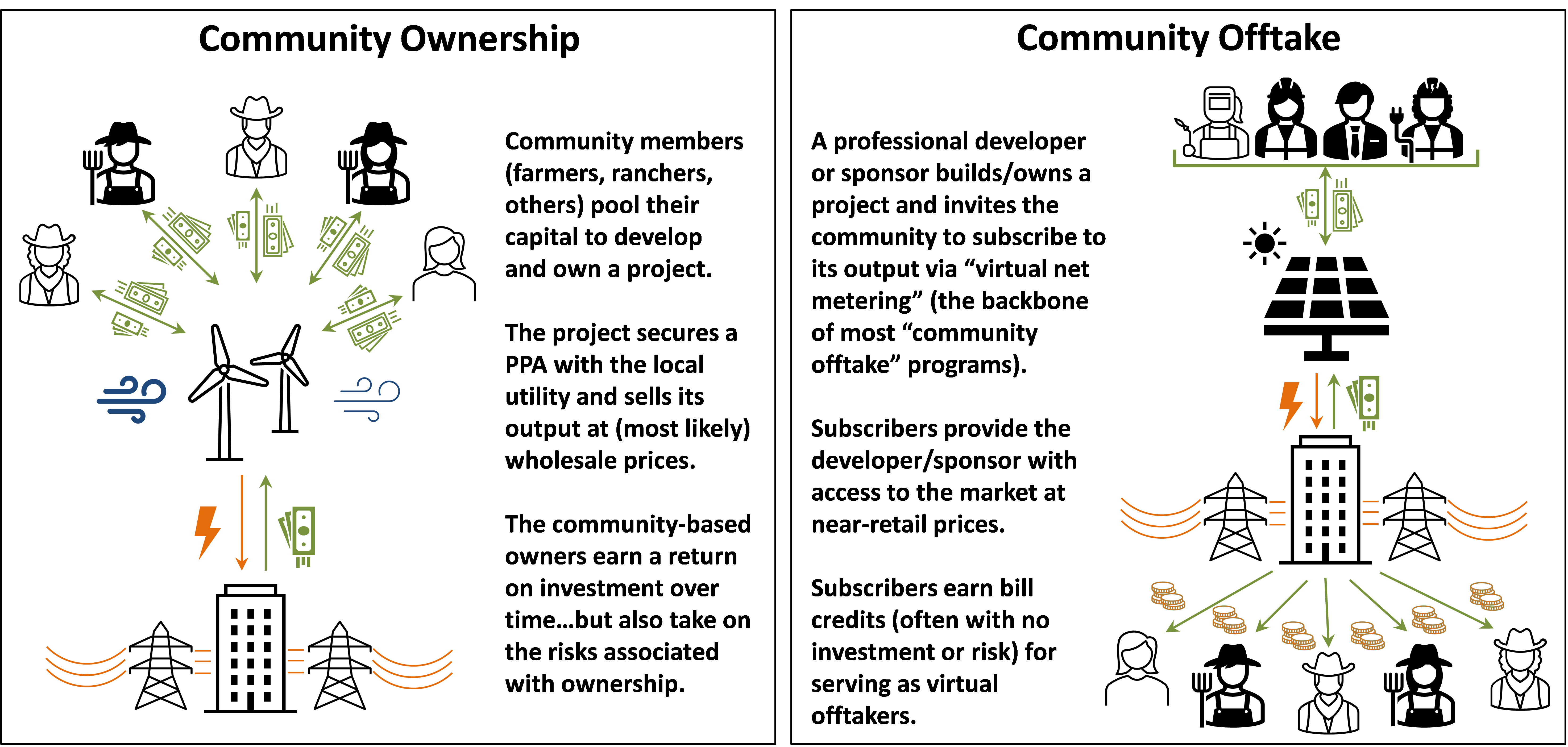
Join Berkeley Lab researchers for a free webinar that will compare and contrast these two “community renewables” markets, with the goal of answering the following questions:
- Why did community wind fade in the U.S. while community solar has thrived?
- What lessons might community wind learn from community solar?
- Are there opportunities for community wind projects to participate in community solar programs across the U.S.? If so, what do the economics look like?
We find that the divergent fortunes of community wind and community solar in the U.S. stem from a variety of factors that can be broadly grouped into three main categories: timing, fundamental technology-related differences between wind and solar, and choice of business model (i.e., community ownership versus community offtake). We focus primarily on the third category—choice of business model—as the most-addressable difference between these two markets, and proceed to research opportunities for community wind to follow solar’s lead by adopting a community offtake model.
Our review of the twenty-two states that have established statewide community offtake programs (typically referred to as “community solar” programs) finds that wind is eligible to participate in at least ten of these states (see the map below).
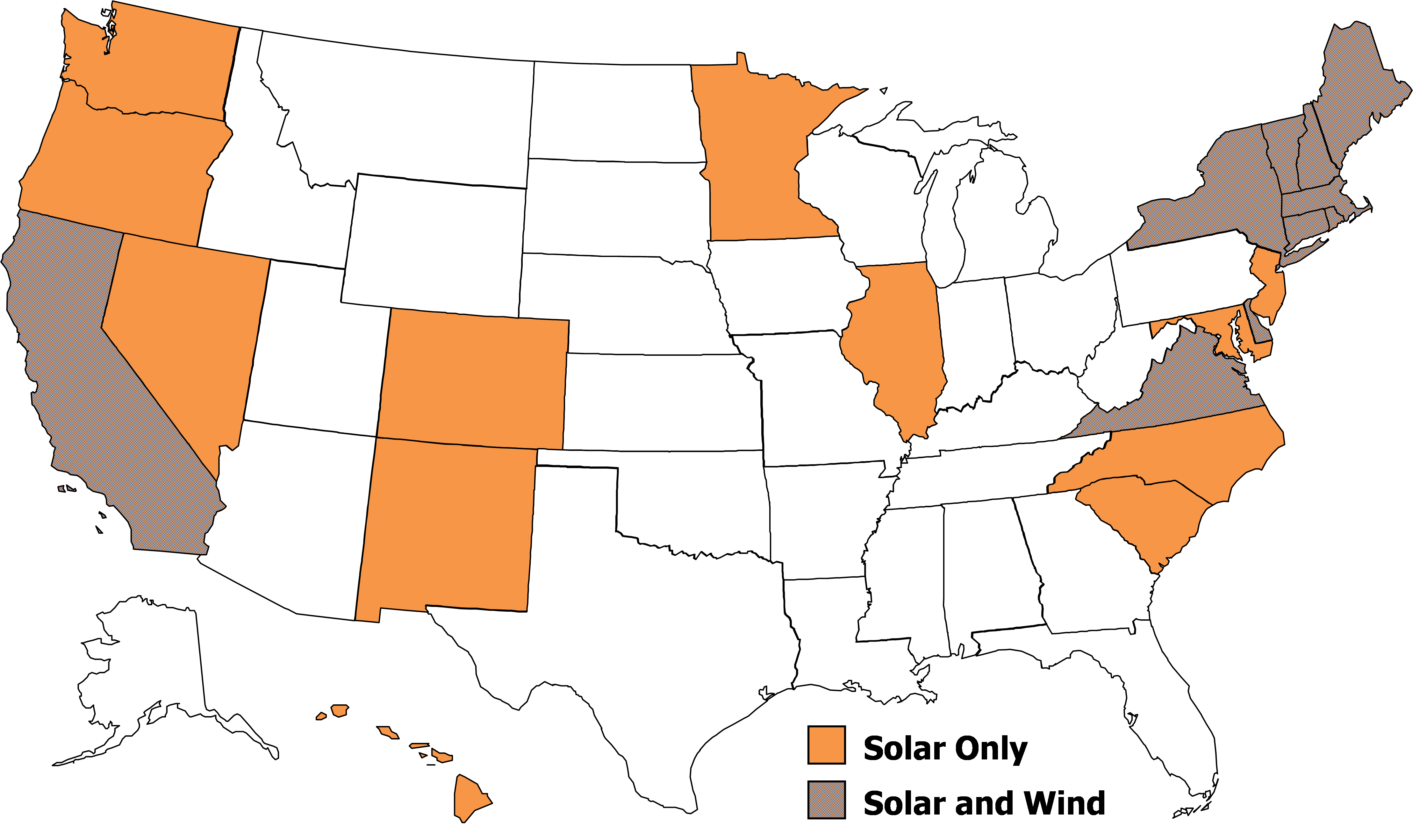
We zoom in on four of the ten states in which wind is eligible to get a better sense for the mechanics of how those programs work and how much revenue would be available to a participating community wind project. We then compare this revenue availability to the typical revenue requirements of a community wind project, taking into account the restored, expanded, and new incentives available to such projects under the Inflation Reduction Act. This comparison reveals opportunities in a number of states for community wind projects to profitably participate alongside solar in these community offtake programs.
Of course, challenges remain, and we conclude with a summary of the primary obstacles, along with thoughts about how to potentially address some of them.
We thank the US Department of Energy’s Wind Energy Technologies Office for funding this work, and hope you find it to be of use.