Integrated Distribution System Planning
Integrated Distribution System Planning
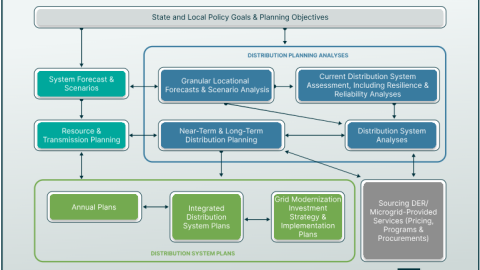
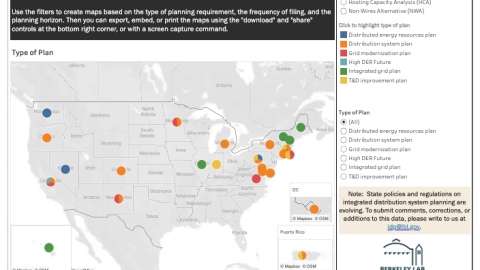
Integrated Distribution System Planning (IDSP) provides a systematic approach to satisfy customer service expectations and state and utility objectives for grid planning and design. It addresses grid reliability, resilience, safety, operational efficiency, and integration and utilization of grid-edge resources and includes a grid modernization roadmap. We provide education, training, and technical assistance on IDSP for public utility commissions, state energy offices, utility consumer advocates, and other state decision-makers. We also conduct research aimed at advancing planning practices. For example, see our online catalog and visualization of state requirements and utility plans.
To ensure effective and reliable grid operations, the U.S. Department of Energy (DOE) is partnering with states and the electric utility industry to develop guidelines and share best practices to assist in the formulation of strategies for distribution system investments.
For an overview of the evolving electricity planning paradigm, listen to the USEA Power Sector Podcast with Berkeley Lab's Senior Researcher Lisa Schwartz.
Register for 2026 NARUC/NASEO SME and Peer-Sharing Webinars (limited to PUCs and State Energy Offices). More information here.
Interactive Decision Framework for Integrated Distribution System Planning About the Framework

Distribution system analyses include engineering, economic, and other technical studies necessary for an effective planning process for local grids. The objective of these analyses is to provide information for distribution planning decisions to meet customer demands, including increased loads from electrification and integration of distributed energy resources (DERs), while ensuring safe, reliable and efficient distribution system operations. The results of distribution system analyses inform the utility's distribution investment strategy and shape near- and long-term planning priorities.
This section of the interactive framework for integrated distribution planning provides information on hosting capacity analysis, DER interconnection, and the value of DERs. Other distribution system analyses conducted by utilities include contingency analysis and thermal loading, power quality, and protection analysis.
Overview
What is the value of distributed energy resources (DERs)?
The value of DERs for the distribution system derives from their capability to provide load relief, reduce power interruptions, address voltage issues, enhance resilience, or meet local energy needs. The potential value of a DER depends on its capability to provide needed grid services at its specific location and at specific times. DERs may be able to cost-effectively defer or mitigate the need for some traditional utility upgrades to distribution infrastructure. In addition to their value to the distribution system, DERs may provide value to the bulk power system and contribute to meeting state and local objectives such as affordability, resilience, renewable energy production and emissions reduction targets. Value of DER can be utilized to develop compensation frameworks that more directly align DER rates and incentives with the benefits that DER provide to the distribution system.
Why is the value of DERs important?
Accurately valuing all potential solutions to meet grid needs, including DERs, is increasingly important to keep down distribution system costs. Distribution system investments are increasing with growth of electrification and distributed generation. When used as a basis for compensation, accurate DER value determinations ensures that the resulting payments or credits are reasonable and justified.
Roles & Responsibilities
Public utility commissions
- Initiate value of DER proceedings for regulated utilities
- Align scope of DER valuation with state objectives
- Ensure stakeholder engagement and input
- Review value of DER study results and oversee implementation in regulatory proceedings
Utilities
- Conduct value of DER studies and integrate findings in decisions on distribution planning, investment and operation
- Provide information on locational value to aid in customer and developer decision-making
State energy offices
- Educate stakeholders on the value of DERs to meet state energy policy objectives
- Provide input for value of DER studies with respect to alignment with state policies and objectives, as well as study scope, objectives, inputs, and assumptions and review results
- Identify high DER value opportunities that may support state goals
Utility consumer advocates
- Participate in stakeholder meetings on the value of DERs to review study scope, objectives, inputs, assumptions, and results
- Provide information for value of DER studies on DER value to customers, customer costs and benefits, and customer concerns
Developers
- Participate in value of DER stakeholder meetings on the value of DERs to review study scope, objectives, inputs, assumptions, and outcomes
- Provide information on value of DER studies with respect to DER capabilities
Other stakeholders
- Participate in stakeholder engagement opportunities for value of DER studies and implementation to provide perspectives on issues such as equitable deployment of DERs and community needs
Best Practices
- Align value of DER assessments with state objectives and priorities
- Include all distribution system benefits when valuing DERs
- Consider time and locational characteristics
- Strike the appropriate balance between complexity, granularity, administrative requirements, and developer and customer experience
- Account for interaction between multiple DERs
- Establish transparency requirements - for example, when comparing the value of traditional distribution assets and DER solutions, assumptions, methodologies, and data should be shared with the regulatory commission and stakeholders
- Account for the expected life cycle of DERs
- Align compensation for DER grid services with DER value through programs and tariffs
- Ensure that customers and developers have sufficient information and knowledge to make informed economic decisions
- Integrate results of value of DER studies in electricity system planning
State Practices
Many states have considered the value of DERs.
- California
- Connecticut
- District of Columbia
- Hawaii
- Maryland
- New York
- Illinois
- Maine
- Massachusetts
- New England
- Nevada
- New Hampshire
- Minnesota
Utility Practices
New York
- Consolidated Edison, Brooklyn-Queens Demand Management Program, Demand Response Program Cost-Benefit Model
- Long Island's Public Service Enterprise Group - VDER Value Stack Calculator
- Utility value of DER tariffs
- Central Hudson
- Con Edison
- National Grid (legal name: Niagara Mohawk Power Corporation)
- NYSEG / RG&E
- Orange and Rockland
Idaho
Flow Chart

Tools
The following publicly available tools and models can be used to perform and support value of DER studies.
-
NREL Distributed Generation Market Demand (dGen) model
- This tool simulates customer adoption of DERs for residential, commercial, and industrial applications through 2050. The model can be applied to analyze the locational value of DERs. Using a database of granular geospatial information, the tool can identify regions, circuits, or specific sites where DERs can provide the most value. This tool has been applied to study the economic value of distributed wind in Colorado, Minnesota, and New York, as well as the economic value of distributed solar and wind in New York.
-
E3 Avoided Cost Model for Distributed Energy Resources
- E3's Avoided Cost Model forecasts the cost-effectiveness of DERs, including energy efficiency, distributed generation, storage, and demand response, considering their time and locational value. The model has been applied in jurisdictions such as California, Nevada, and New York.
-
EPRI DER-VET™
- This tool supports locational analyses of the value of DERs, such as storage, solar, demand response, and electric vehicles. The tool uses inputs such as load, system configuration, and site characteristics to determine optimal size, duration, and other characteristics for maximizing benefits based on site conditions and the value that can be extracted from targeted use cases.
-
LBNL Time-Sensitive Value Calculator
- The Excel-based tool by Berkeley Lab estimates the value of energy efficiency and other DER measures using hourly estimates of electricity system costs. The tool takes hourly profiles of up to six measures at a time and monetizes their value for six value streams, producing outputs in tabular and graphical formats. Resources for the tool include a training webinar and a user manual.
Resources
This report discusses current methods to assess DER value for wholesale electricity markets and distribution systems in several regions of the United States.
The purpose of the study is to inform the Public Service Commission of the District of Columbia and stakeholders about the potential value of DERs to keep down electricity system costs associated with generation, transmission, and distribution. The study found that wholesale energy and capacity market costs, distribution upgrade costs, and societal costs associated with greenhouse gas emissions are the greatest contributors to costs caused by increasing electric loads. They therefore are the largest sources of value for DERs that can avoid these costs.
This study analyzes the value of distributed storage for residential customers and the grid. While batteries enhance resilience for the host customer and may provide bill savings, current rate structures may not incent operation that provides value to the grid. This inefficiency is due to: (1) misalignment in the timing of battery dispatch relative to market value, and (2) batteries used solely for solar self-consumption standing idle on peak days. The authors show that incentivizing storage customers to respond to market prices, particularly on peak days, would enhance both private and public value.
This study assesses the locational value of distributed solar and wind resources in New York. Using New York’s Value of DER framework, the analysis finds that most DER systems would receive a modest compensation from their contribution to deferring system upgrade costs, with a subset of DER projects receiving a greater compensation for their value.
This study analyzes the impacts of deploying DERs using a range of adoption scenarios for Indiana by 2025 and 2040. The authors estimate the economic value of DERs using capacity expansion and power flow analyses.
This report identifies ways to increase the grid value of distributed storage by aligning utility rates and incentive programs with grid needs, resulting in beneficial adoption and dispatch of storage assets.
This report focuses on potential DER benefits for distribution systems, primarily in their role as non-wires alternatives to defer, mitigate, or eliminate the need for some traditional system investments at locations where distribution capacity is insufficient to meet expected future needs. It describes approaches and tools to estimate the locational value of DERs. The report includes 24 case studies to illustrate how states and utilities are considering the locational value of DERs.
This report focuses on enhancements to methods and practices for determining the value of demand flexibility in grid-interactive efficient buildings for providing grid services. The report includes examples of how utilities and states commonly use DER valuation methods. The report includes resources and implementation guidance to enhance existing methods.
This manual provides guidance for assessing the economic value of DERs using benefit-cost analyses. Information and use case examples are provided for conducting benefit-cost analyses for an individual DER or a portfolio of DERs. DERs covered include energy efficiency, demand response, distributed generation, distributed storage, electric vehicles, and electrification of building loads.
This report reviews industry practices on hosting capacity analysis and DER locational value assessment. For locational value, the report describes use cases including non-wires alternatives procurement, tariff design, and program design. For each use case, the report provides an overview of the state of the industry, challenges and considerations.
This report proposes a framework for integrated analysis of DERs at three levels: single DER, multiple DERs, and integrated DER and utility system.
This meta-analysis for the U.S. Department of Energy focused on studies produced by 15 states on the value of distributed solar and net metering. The studies reviewed were published between 2014 and 2017. The report highlights the range of value categories, quantification methods, and assumptions that may be used to determine the value of DERs.
This study, for Con Edison, identifies marginal costs at the distribution network or feeder level using projected costs and loads for a 10-year period. Among other uses, the location-based results supported Value of DER proceedings.
This report assesses the value of DERs as a distribution grid asset and provides a methodology to quantify their locational value. The report also describes the drivers of locational value, such as characteristics of local load and distribution grid assets, and DER operational characteristics.
This report describes utility approaches to value the temporal and locational value of DERs. The report documents the results of a study with Consolidated Edison, New York, and Southern California Edison, California. The authors emphasize the importance of systematic and detailed approaches to assessing the value of DERs.
This report focuses on methods, tools, and data that can be used to determine the benefits and costs of distributed PV. Among the benefits covered are energy; environmental; transmission and distribution losses; generation, transmission, and distribution capacity; and ancillary services.
This report provides a meta-analysis of methodologies and identifies existing gaps in analyzing the costs and benefits of distributed solar. The authors reviewed 16 studies on the benefits and costs of distributed solar, published between 2005 and 2013.
Overview
What is hosting capacity?
Hosting capacity is the amount of distributed energy resources (DERs) that can be interconnected without adversely impacting power quality or reliability under existing control and protection systems and without infrastructure upgrades.
Why is hosting capacity analysis important?
Hosting capacity determines the ease and cost of interconnecting DERs like distributed PV. If there is insufficient hosting capacity at the point of interconnection, the customer cannot install PV unless they directly pay for distribution system upgrades. Publicly available hosting capacity maps and associated data help customers and developers target DER siting. The information also helps streamline interconnection processes and supports distribution system planning.
Roles & Responsibilities
Public utility commissions
- Establish HCA requirements for regulated utilities, including objectives and use cases
- Review HCA filings including costs and benefits of potential enhancements
- Provide guidance on transparency and HCA improvements
Utilities
- Conduct hosting capacity analysis (HCA) and facilitate stakeholder input
State energy offices
- Participate in HCA technical meetings and, in some states, regulatory proceedings to ensure HCA use cases and information - and hosting capacity upgrades - support state policies and programs that reduce barriers to DER and EV adoption
- Conduct studies to identify likely locations for additional distributed generation and EV charging and assess where distribution hosting capacity upgrades may be particularly important
Utility consumer advocates
- Participate in technical meetings and regulatory proceedings to review HCA costs and benefits, data-sharing and customer privacy provisions, and potential HCA enhancements
Developers
- Participate in HCA technical meetings and regulatory proceedings to support accurate HCA information at the appropriate level of detail and in standard data formats to guide siting of DERs and EV charging stations
Other stakeholders
- Ensure that hosting capacity upgrades provide equitable access to DERs and EVs and meet other community needs
Best Practices
- Identify hosting capacity use cases and expected outcomes.
- Schedule updates for maps and associated data at a frequency that serves identified use cases.
- Provide sufficient data granularity - ideally, circuit section maps.
- Set the size of DERs to facilitate projects most likely to face interconnection constraints - e.g., up to 20 MW.
- Identify the specific criteria (thermal, power quality/voltage, protection, or safety/reliability) that limits hosting capacity on each feeder.
- Identify all constraints being evaluated and the magnitude at which criteria are violated to enhance understanding of likely upgrade costs.
- Implement a data-sharing framework that considers stakeholders' data needs, such as maps and data file downloads, with due consideration for customer privacy and grid security.
- Consider probabilistic hosting capacity values, based on scenarios with varying DER penetration, size, and location.
- Include additional types of DERs over time, such as energy storage.
- Incorporate load, such as electric vehicle charging and demand flexibility.
- Establish flexible processes to facilitate changes that support existing and additional use cases.
- Needed next step: Estimate hosting capacity for all hours, not just the hour with minimum annual load.
State Practices
Many states have established hosting capacity analysis requirements for regulated utilities.
- California - Decision 17-09-026 September 28, 2017
- Colorado - Rule 3531 and 3541
- Connecticut - Docket No. 17-12-03RE07 Appendix A, Decision November 9, 2022
- District of Columbia - Order No. 20364
- Hawaii - Docket 2014-0192 Decision and Order No. 34924
- Illinois - Illinois Public Utilities Act, Section 16-105.17(f)
- Massachusetts - D.P.U. 19-55-D, Order from September 16, 2020
- Michigan - Docket 20147, Order from August 20, 2020
- Minnesota - Docket No. E-002/M-21-694, Order from July 26, 2022
- Nevada - Regulation Of Public Utilities, Section 704.9327
- New Hampshire - Title XXXIV Public Utilities Chapter 362-a Limited Electrical Energy Producers Act, Section XXII
- New York - Docket 16-M-0411, Order of March 9, 2017
- Oregon - Docket UM-2005, Order 20-485
- Rhode Island - Docket 4756, Order No. 23385
- Vermont - Guidance for Integrated Resource Plans and 202(f) Determination Requests
Utility Practices
Following are links to utility hosting capacity data - for PV only or multiple types of DERs:
- California - PG&E, SCE, SDG&E (DERs)
- Colorado - Xcel
- Connecticut - Eversource
- Delaware - Pepco
- Hawaii - HECO
- Illinois - ComEd, Ameren
- Massachusetts - National Grid, Eversource, Unitil
- Michigan - Consumers Energy, DTE
- Minnesota - Xcel
- Nevada - NV Energy
- New Hampshire - Eversource, NHEC, Unitil
- New York - NYSEG and RG&E (PV, Electrification, ESS), O&R, National Grid (PV, Electrification, ESS), ConEdison, Central Hudson (PV, ESS)
Flow Chart

Tools
The following tools and models can be used by utilities to perform and support HCA:
- Eaton CYME
- DNV SYNERGI
- EPRI DRIVE
- NREL DISCO (Distribution Integration Solution Cost Options)
- LBNL LODGE (Least-cost Optimal Distribution Grid Expansion) (Example analysis)
Resources
This paper assesses challenges and solutions for EV-focused HCA, emphasizing the importance of performance constraints, scenarios, data availability, and methods.
This training provides an overview of HCA use cases, map information elements, and trade-offs. It also covers DER forecasting and non-wires alternatives analysis.
The detailed framework is designed to assist public utility commissions and stakeholders in addressing issues related to access to utility grid data, including for HCA. The framework includes use cases, state priorities, current practices, outcomes, data details, potential impacts, and data-sharing tactics.
This summary reviews current practices and policy context for grid data sharing, including for HCA applications. It also summarizes trends observed in state proceedings.
This study assesses the impact of community solar projects on the distribution grid, using Berkeley Lab's Least-cost Optimal Distribution Grid Expansion (LODGE) model to identify impacts on a range of distribution feeders. The authors use the results to provide policy and regulatory insights.
This U.S. Department of Energy website provides a list of utility HCA maps covering 24 states and the District of Columbia. The resource identifies 39 unique HCA maps.
This paper reviews HCA definitions, methods, limiting constraints, and approaches to improve analysis for distribution grids.
This report provides best practices for HCA data validation to support utilities, regulators, and other stakeholders and increase confidence in HCA results, contributing to planning efforts and DER interconnection. Best practices include clear roles and responsibilities for the HCA team, designing a repeatable process, and transparency and information-sharing.
This report, produced for the Minnesota Public Utilities Commission, focuses on customer privacy and grid security issues related to HCA and the availability of distribution grid data. The report includes short-term and long-term recommendations for the PUC and Xcel Energy's HCA.
This report covers a range of issues and decisions that can be considered when making HCA results publicly available. For each issue addressed, the report identifies options to consider. The report also includes regulatory process decisions that may be considered. Topics covered include stakeholder engagement, use cases, implementation, methodologies, analysis updates, access to data and privacy, grid security, and accessibility.
This report focuses on potential DER benefits for distribution systems, primarily in their role as non-wires alternatives to defer, mitigate, or eliminate the need for some traditional system investments at locations where distribution capacity is insufficient to meet expected future needs. It describes approaches and tools to estimate the locational value of DERs, including the role of HCA, and reviews state requirements for HCA and utility HCA maps.
This paper summarizes drivers, impact assessment, challenges, and best practices for implementing HCA. It identifies enhancements for HCA methods and standardization needs.
This book introduces HCA and its developments and provides information for utilities, investors, and researchers interested in advancing HCA. The content covers HCA concepts, methods, performance limits, and case studies.
This report assesses analytical tools and methods, including HCA, to support distribution system planning with DER and grid modernization. For HCA, the report covers existing tools and approaches and identifies advanced functionalities needed.
This presentation to the NARUC Staff Subcommittee on Energy Resources and the Environment provides perspectives from three stakeholders on HCA.
IREC provides an overview of the value of hosting capacity and technical considerations, including implementation considerations. Pepco Holdings presents lessons learned from a utility perspective. Borrego Solar presents lessons learned from a developer's perspective.
This report identifies factors that impact hosting capacity, reviews industry methods, and describes the value of different HCA use cases, including informing developers and the public, interconnecting screening, and DER planning.
This report focuses on inputs and assumptions used to calculate hosting capacity. It presents the impact of each input and provides recommendations to avoid incorrect estimations of hosting capacity.
This report builds on state and utility experiences with HCA to provide guidance to regulators considering pursuing this tool for distribution grid planning and modernization efforts.
This report focuses on the role of HCA in improving the interconnection of DERs and points to New York and California for best practices. The report discusses why rules of thumb are ineffective when connecting DERs to the distribution system.
This report describes the value of HCA to utilities, customers, and stakeholders. It also outlines objectives and challenges of use cases.
This report presents a phased approach and methodology for DER hosting capacity for New York. The phased approach includes four steps with increasing complexity, effectiveness, and data requirements. For each step, the report describes data requirements, outcomes, and outputs. The report also describes implementation needs and challenges.
This report describes EPRI's streamlined HCA method, its implementation in distribution system planning, and data requirements for determining HCA.
This website provides an overview of HCA and its importance for a variety of use cases. The website links to resources including articles, blogs, webinars, and reports.
This website provides an overview of approaches to conducting HCA and links to HCA guides for utilities, policymakers, and PV developers.
Overview
What is interconnection?
Interconnection is the result of the process of adding a distributed energy resource (DER) to a distribution system (IEEE Standard 1547-2018). The term may refer to the technical, procedural, and legal requirements of the interconnection process or the interface between the DER and the utility's distribution system - the physical location at which the DER provides certain electrical and interoperability capabilities.
Why is interconnection important?
Interconnection allows utility customers and third-party service providers to connect solar energy systems, energy storage, and other generating systems at customer premises and operate them in parallel with the utility system. In addition to providing services to meet their own electricity needs, customers can use interconnected DERs to sell power or ancillary services to the utility at the distribution or bulk electric system - for example, through a DER aggregator.
Roles & Responsibilities
Public utility commissions
- Establish interconnection rules, technical requirements, and procedures for jurisdictional utilities
- Oversee utility administration of interconnection requirements and processes
Utilities
- Develop, administer and enforce interconnection technical requirements
- Develop interconnection-related tariffs
- Conduct interconnection studies
- Authorize interconnection/issue permission for utility customers and third-party service providers to operate DERs that maintain the safety, reliability, resilience, and security of the electric grid
- Execute Electric Reliability Organization enterprise requirements by regional reliability coordinators
State energy offices
- Assist and support implementation of state energy interconnection policies and regulations
- Support or lead compliance monitoring and reporting
- Compile and disseminate statewide data and information
- Fund and administer interconnection-related research, development, and demonstration projects
Developers
- Participate in technical meetings and regulatory proceedings to support provision of accurate information, at the appropriate level of detail and in standard data formats, to guide siting of DERs including electric vehicle (EV) charging stations
- Build, operate, and maintain interconnected DER systems
Utility consumer advocates and other stakeholders
- Participate in technical meetings and regulatory proceedings to review interconnection costs and benefits, data-sharing, and customer privacy provisions and potential enhancements
- Participate in technical meetings and regulatory proceedings regarding interconnection rules, technical requirements, processes, and tariffs to support equitable access to DERs, including EV charging, and meet other stakeholder and community needs
Best Practices
- When developing and updating interconnection rules, procedures, or technical requirements:
- Identify motivations and desired goals (outcomes).
- Identify all relevant stakeholders.
- Provide sufficient opportunities for stakeholder discussion and collaborative resolution of issues.
- Incorporate the latest technical standards such as IEEE Standard 1547-2018 and IEEE Standard 2800-2022 into statewide policy.
- Remove barriers to enabling use of advanced DER and inverter-based resource capabilities.
- Develop a long-term strategy for updating interconnection processes over time.
- Develop and track metrics to evaluate progress towards desired goals.
- Establish adaptable interconnection processes that can support additional DER use cases.
- Enable flexible interconnection to allow customers to agree to curtail load in lieu of paying for distribution system upgrades.
- Include additional types of DERs over time, such as energy storage.
- Include different DER configurations, such as intentional islands where DERs can operate independently from the utility system - at all times or during times of distribution system instability.
State Practices
Many states have established interconnection requirements for jurisdictional utilities - most commonly, for solar energy systems under Net Metering. The map shows states that have adopted IEEE Standard 1547-2018 for interconnection, including requirements for smart inverters that can help the grid accommodate higher levels of distributed renewable energy resources.

Typical requirements for utilities for state-jurisdictional DER interconnection include the following categories:
- System size (generation capacity)
- Technology and technical standards (e.g., types of DERs, applicable interconnection technical performance standards such as IEEE Standard 1547-2018)
- Application processes, timelines, and fees
- Limitations on liability insurance requirements
- Technical screens
- Customer redress
The Oregon Public Utility Commission's interconnection rules (Order No. 24-068 in Docket AR 659) provide an example of a comprehensive approach.
For DER interconnection under federal jurisdiction (e.g., DERs selling to wholesale markets), Federal Energy Regulatory Commission Order 2023 adopted reforms to ensure that the generator interconnection process is just, reasonable, and not unduly discriminatory or preferential.
Utility Practices
Utilities may publish supplementary guidance on interconnecting DERs to their system. Following are example technical interconnection and interoperability requirements.
- East Kentucky Power Cooperative interconnection requirements
- LUMA (Puerto Rico) Technical Interconnection Requirements (Case no. NEPR-MI-2019-0009, 2022)
- National Grid interconnection process and procedures
- Arizona Public Service interconnection documents and requirements
- Eversource interconnection guide (Massachusetts)
Flow Chart

Tools
Utilities and project developers can use the following tools and models to perform and support interconnection.
- Prospecting DER Locations and Interconnection Review
- Hosting Capacity Analysis
- Interconnection Application
- Clean Power Research: PowerClerk
- AHJ Review
- SolarApp+, an online tool designed to help governments and installers streamline solar permitting and installation
- DER/IBR Integration (utilization of capabilities)
- Distribution Management System: Network Manager SCADA/Distribution Management System (ABB)
- Distributed Energy Resource Management System: SmarterGridSolutions (Mitsubishi Electric)
- Advanced Distribution Management System: GE Vernova's ADMS, Oracle's ADMS, Siemens' Spectrum ADMS, and Schneider Electric's EcoStruxure ADMS
- DER/distribution planning and modeling
Resources
The i2X initiative enables simpler, faster, and fairer interconnection of clean energy resources while enhancing the reliability, resiliency, and security of electricity grids. The i2X website includes resources for states, utilities, and stakeholders.
This website provides links to educational materials on adoption of IEEE Standard 1547-2018.
This website provides a comprehensive list of interconnection guidelines across the U.S.
This website provides a curated list of state and utility activities related to adoption of IEEE Standard 1547-2018.
This website answers FAQs on interconnection.
This document presents multiple paths to consider for process reforms to address a jurisdiction's unique challenges and priorities for distributed energy resource (DER) interconnection.
This toolkit includes reports, webinar presentations, and model language for interconnection rules to help improve interconnection of energy storage as well as solar plus storage systems.
This chapter of EPA's guide describes state experiences with interconnection standards and net metering policies to facilitate the adoption of DERs, such as rooftop solar, energy storage, and combined heat and power.
This document provides recommended practices for interconnection procedures.
This report summarizes timelines for utility approval of interconnection requests.
This slide-deck report provides recommendations to help educate state utility regulators and others about FERC and Regional Transmission Organization/Independent System Operator processes to support state policies that unlock DER value.
This report summarizes considerations, practices, and emerging solutions across a broad set of topics related to DER interconnection, such as advanced inverters, technical screens, timelines, mitigating impacts of distributed energy resources, and cost allocation.
This paper describes flexible interconnection options to reduce DER interconnection costs, in particular options that involve real-power control.
This handbook describes challenges with high shares of PV interconnection and offers recommended solutions.

What are DER/microgrid-provided services and how are they sourced?
Some distribution system needs may be met by distributed energy resources (DERs) or microgrids. DERs include energy efficiency, demand flexibility, distributed generation and storage, and managed electric vehicle charging. A microgrid is a group of interconnected loads and DERs within clearly defined electrical boundaries that act as a single controllable entity with respect to the grid. A microgrid can operate in grid-connected or island mode, including entirely off-grid applications.
Utilities may source solutions through pricing, programs, and procurements for non-wires alternatives. Pricing includes designing new or adapting existing tariffs for utility customers to include location- and time-sensitive distribution system benefits of DERs. Programs include focusing incentives or providing greater incentives to address a specific locational grid need through energy efficiency, demand response, distributed generation, energy storage, or a portfolio of DERs. Utilities can procure non-wires alternatives to defer traditional distribution system investments, such as a new feeder, by deploying DERs targeted to address specific grid needs identified in the planning process.
This section of the interactive IDSP framework provides information on geotargeting programs and non-wires alternatives procurements. Other important topics, not addressed here, include distribution-level markets, standard services agreements, and grid codes for institutional and business processes and engineering practices for DER integration and utilization.
Overview
What are procurements for non-wires alternatives?
Non-wires alternatives (NWAs), also called non-wires solutions, are distributed energy resources (DERs) such as energy storage, energy efficiency, and demand flexibility that provide grid services at specific locations to defer or mitigate traditional utility infrastructure investments such as feeder and substation upgrades. NWAs may provide load relief, reduce power interruptions, address voltage issues, improve resilience, and meet local energy needs.
NWA procurement follows the utility's grid needs assessment to determine the location and timing of constraints on the distribution system. Procurement typically is through a competitive solicitation, such as a request for proposals (RFP) or auction, for third party solutions. Some states allow utilities to own NWAs, such as batteries. Utilities also may source NWAs by geotargeting DER programs and through pricing mechanisms.
Why are NWAs important?
NWAs expand the set of options to solve identified grid needs. Procured solutions may reduce utility costs if they defer or mitigate infrastructure upgrades. Another benefit is flexibility to meet grid needs incrementally, as projected higher loads materialize. NWAs also can support state renewable energy and emissions reduction goals and encourage utility innovation to meet customer needs.
Roles & Responsibilities
Public utility commissions
- Establish guidance for regulated utilities on NWA analysis and procurement.
- Establish cost recovery mechanisms.
- Review proposed NWAs in utility filings.
Utilities
- Establish NWA screening criteria, evaluation standards, and procurement processes.
- Conduct solicitations for grid needs suitable for NWAs.
- Potentially own and operate NWAs, if permitted by state.
- Review NWA operational performance against contract requirements.
State energy offices
- Conduct studies on NWA potential, barriers, and opportunities.
- Participate in or facilitate stakeholder meetings to address NWA issues.
- Participate in regulatory commission proceedings, including technical meetings, to ensure NWA processes and procured solutions align with and support state policies and programs.
Utility consumer advocates
- Participate in stakeholder meetings to address NWA issues.
- Participate in regulatory proceedings, including technical meetings, and provide recommendations for improvement and feedback.
- Advocate for opportunities for consumers to participate in and be fairly compensated for the NWA value provided by DER.
Developers
- Participate in stakeholder meetings to address NWA issues.
- Participate in regulatory proceedings to support development of NWA requirements and processes that are likely to yield successful procurements.
- Participate in utility solicitations for NWAs.
- May own and operate NWAs.
Other stakeholders
- Ensure that NWA processes and procured solutions align with community needs and consider equity, environmental, economic development, and other interests.
Best Practices
- Integrate NWA analysis and procurement in distribution system planning processes.
- Establish appropriate lead times for grid needs identification, NWA planning, procurement, and deployment.
- Develop standard, robust suitability criteria to effectively identify the most viable NWA projects.
- Specify cost-effectiveness standards for NWA screening.
- Provide adequate grid data to developers for competitive solicitations for NWAs.
- Deploy a technology-agnostic portfolio approach for NWAs.
- Conduct inclusive and collaborative stakeholder engagement processes to align NWA procurement with community needs and public interests.
- Implement standard pro forma agreements.
- Offer vendor pre-qualification options to reduce procurement timeline.
- Establish transparent rules for NWA ownership and operation.
- If viable NWA bids are insufficient to meet grid needs, consider combining NWAs with infrastructure upgrades to more cost-effectively meet the same need as the standalone utility solution.
- Consider contingency planning for procured NWA projects to reduce risk of non-performance.
- Use data and lessons learned from completed NWA procurements and implementationto inform future efforts and refine approaches. Coordinate NWA procurements with DER programs.
State Practices
Many states have established NWA requirements for regulated utilities:
- California
- Colorado
- Connecticut
- Delaware
- District of Columbia
- Hawaii
- Illinois
- Massachusetts
- Maine
- Michigan
- Minnesota
- Nevada
- New York
- Oregon
- Rhode Island
- Virginia
- Vermont
Utility Practices
Following are examples of utility practices for NWAs:
- California
- Hawaii
- Nevada
- New York
Flow Chart

Tools
The following tools and models can be used by utilities to support non-wires alternatives.
- Circuit modeling and power flow tools (Eaton CYME, DNV Synergi, Milsoft Windmil, OpenDSS)
- DER Value Estimation Tool (DER-VET), developed by the Electric Power Research Institute (EPRI)
Resources
This report provides an overview of NWA procurement as of several years ago, including hurdles and best practices. The report draws on NWA procurement experiences in California, Connecticut, New York, Massachusetts, and Rhode Island.
This report reviews NWA solicitations and related commission proceedings in Connecticut, Maine, New Hampshire, New Jersey, and New York and identifies challenges and opportunities.
This guide identifies approaches to support implementation and scaling of NWAs and provides recommendations to improve NWA planning and operational processes. The report draws on insights from 15 states and over 20 utilities and includes perspectives from developers, regulators, and trade associations.
This report provides insight from 10 representative case studies of NWA projects in the United States. Building on the information draw from the case studies, the report describes lessons learned and challenges related to NWA planning, sourcing, and program and technology implementation.
This report identifies best practices for utilities and regulators to implement distribution system planning processes that support NWAs. The report focuses on how utilities and regulators can create a marketplace for NWAs while supporting grid reliability, affordability, and security.
This presentation defines NWAs and the locational value of DERs and describes the role of cost-effective NWAs in the context of distribution planning. It also provides an overview of state NWA requirements and insights from regulatory proceedings and utility practices in Minnesota, New York, and Nevada.
This report provides an overview of principles, practices, and emerging issues in competitive solicitations that allow all resource types to participate to meet utility needs, including for the distribution grid. For NWAs, the report outlines steps in the procurement process and provides example procurement processes in New York, Hawaii, and California. The report also provides examples of NWA suitability criteria and describes the process to evaluate and select NWAs.
This report focuses on potential DER benefits for distribution systems, primarily in their role as NWAs to defer, mitigate, or eliminate the need for some traditional system investments at locations where distribution capacity is insufficient to meet expected future needs. It describes approaches and tools to estimate the locational value of DERs and
This presentation includes the types of grid services sourced through NWAs and procurement mechanisms that states have adopted.
Overview
What are geotargeted programs?
These utility customer programs focus incentives, or provide higher incentives, for distributed energy resources (DERs) - energy efficiency, demand response, distributed generation and storage, and managed electric vehicle charging - to reduce load growth for specific locations on the distribution system and reduce the need for system upgrades. Utilities and third-party administrators operate geotargeted programs, with funding provided by utility customers. Programs typically provide an upfront incentive or rebate for installation of a specific technology (e.g., an energy-efficient appliance, smart thermostat, or solar plus storage system), opportunities to earn revenues for operating qualifying technologies, or provide both upfront and ongoing incentives. Geotargeted programs are another way to source non-wires alternatives (NWAs), also called non-wires solutions.
Why are geotargeted programs important?
Geotargeted programs can leverage existing offerings and customer relationships to address specific grid needs. That may reduce the timeline between identifying grid needs and deploying solutions. New geotargeted programs can leverage previous experience in program design, participant recruitment and retention, and impacts to facilitate program effectiveness.
Roles & Responsibilities
Public utility commissions
- Establish requirements for sourcing NWAs, including geotargeted programs, for both distribution planning and tariff filings.
- Establish cost recovery mechanisms.
- Review proposed geotargeted programs in distribution planning and tariff filings.
Utilities
- Identify distribution system needs suitable for NWAs with sufficient lead time to enable geotargeting program implementation (e.g., as part of a 5- to 10-year forecast).
- Assess the potential of existing or new utility programs to address identified grid needs, with stakeholder engagement.
- Adapt existing or establish new DER programs that geotarget incentives to align with specific grid needs and commission requirements.
- Propose adapted or new geotargeted programs for regulatory approval.
- Review program performance and revise programs as needed.
- For control-based resources (e.g., demand response), ensure system operators have the capability and training to use geotargeted program resources for local distribution capacity when needed.
Third-party program administrators
- Design and deploy geotargeted programs aligned with identified utility grid needs as approved by regulators.
State energy offices
- Participate in stakeholder meetings and regulatory proceedings to ensure proposed geotargeted utility or third party-administered programs align with state policies and programs and make recommendations for program improvements.
- Provide input on proposed regulatory requirements for NWAs, including geotargeted programs.
Utility consumer advocates
- Participate in stakeholder meetings and regulatory proceedings to review proposed requirements for NWAs and proposed programs and make recommendations for improvements.
DER developers
- Participate in regulatory proceedings to support the development of effective NWA requirements and processes and contribute to program design and offerings.
Other stakeholders
- Participate in stakeholder and regulatory processes to provide feedback on NWA processes and geotargeted programs, including consideration of customer and community needs and equity, environmental, economic development, and other interests.
Best Practices
- Require utilities to analyze geotargeted programs as NWAs in distribution planning and program development and implementation processes, including filing methods and results.
- Establish processes to consider changes that may be needed in program scope, design, and implementation, such as recruitment approaches and incentive levels, to meet identified grid needs as they change over time.
- Identify program limiting factors, such as number of potential participants and potential load response resulting from the program.
- Structure programs to allow for flexibility and replicability to reduce the costs of adapting existing or launching new geotargeted programs.
- Analyze effectiveness of different types of customer incentives to support program success.
- Design program marketing and outreach efforts to engage customers effectively, considering the needs and interests of different types of customers.
- Account for the program ramp time, including the time it takes customers to decide to enroll in program offerings and the time it takes to build a sizable resource. Commercial and industrial customers may require longer lead times.
- Coordinate geotargeted program offerings with other NWA efforts pursued through procurements and pricing.
- Use program data and lessons learned to inform future efforts and refine approaches, including participant recruitment and retention, incentive structure and levels, and types of program offerings.
State Practices
Many states have established processes and requirements for geotargeted programs in the context of NWAs.
- California
- Colorado
- Connecticut
- Delaware
- District of Columbia
- Hawaii
- Illinois
- Massachusetts
- Maine
- Michigan
- Minnesota
- Nevada
- New York
- Oregon
- Rhode Island
- Virginia
- Vermont
Utility Practices
Following are examples of utility practices for geotargeted programs.
- Michigan
- Minnesota
- New York
- Rhode Island
- Vermont
Flow Chart

Tools
Utilities can use the following tools and models to support geotargeting programs.
- URBANOPT - URBANopt Advanced Analytics Platform (NREL)
- DER-CAM - Distributed Energy Resources Customer Adoption Model (LBNL)
- CityBES - City Buildings, Energy, and Sustainability (CityBES) is a web-based data and computing platform (LBNL)
- UrbanFootprint
- XeroHomes
Resources
This report describes the process, results, and lessons learned from a geotargeted pilot program by the Center for Energy and Environment in partnership with Xcel Energy. The program successfully tested a geotargeted approach, consisting of energy efficiency and demand response for residential and commercial customers, for deferring a new transformer, feeder, and feeder configuration. Peak demand savings exceeded the goal.
This report focuses on potential DER benefits for distribution systems, primarily in their role as NWAs to defer, mitigate, or eliminate the need for some traditional system investments at locations where distribution capacity is insufficient to meet expected future needs. The report includes case studies of geotargeted utility programs implemented by Consumers Energy in Michigan and Xcel Energy in Minnesota.
This report identifies approaches to support adoption of non-wires solutions and provides planning and operational recommendations to improve processes. The report draws on insights from 15 states and over 20 utilities and includes perspectives from developers, regulators, and trade associations. Recommendations aim to support implementation and scaling of non-wires solutions. The report discusses geotargeting existing and new programs.
This report provides insights from 10 representative case studies of NWA projects in the United States. It describes lessons learned and challenges related to planning, sourcing, program implementation, and technology implementation. For geotargeted programs, the report provides details on utility programs implemented by Central Hudson Gas & Electric, Con Edison, Consumers Energy, and National Grid.
This report focuses on geotargeting energy efficiency programs to defer utility investments in transmission and distribution assets. The report describes a range of case studies across the U.S. that deployed energy efficiency by itself or in combination with other DERs to defer traditional utility investments.
Resource and Transmission Planning
Bulk power system and distribution system planning processes require coordination to efficiently meet customer needs and ensure safe, reliable, and affordable electricity. Coordination also is important to align resource and transmission plans — including data, assumptions, and scenarios—with near- and long-term distribution planning priorities.
Utilities conduct integrated resource planning (IRP) to identify long-term investments to meet reliability requirements and public policy goals at a reasonable cost. Independent System Operators, Regional Transmission Organizations, utilities, and independent transmission companies conduct transmission planning to ensure adequate capacity and reliability on high-voltage systems that transport electricity from remote generating facilities to utility distribution service areas.
Scenario model results for IRP and transmission planning related to distributed energy resource (DER) adoption and operational use in bulk power systems are critical inputs for distribution planning. Conversely, high levels of DERs at the distribution level may reduce the need for bulk power system resources, both generation and transmission. Also, DER variability can detrimentally affect bulk power system operation if not managed, so it is important to simulate DER behavior under various conditions in planning models.
System Forecast & Scenarios
Utility system-level forecasts provide projections of loads and distributed energy resources (DERs) and are key inputs for distribution system planning as well as resource and transmission planning. These forecasts reflect economic, policy, regulatory, and technological trends. Forecasts can be developed for multiple time horizons and geographic aggregation levels. In addition to a baseline forecast, ideally system-level forecasts include scenarios that represent various plausible futures that differ from base case assumptions to inform needed flexibility and test robustness of the plan under different potential conditions.

What is the role of state and local policy goals and planning objectives in distribution planning?
State and local policy goals are key inputs for integrated distribution system planning (IDSP). Planning objectives and priorities originate from these goals as well as input from communities and stakeholders. Policy goals may emerge from the state legislature, governor, city council, or county board. Utility regulatory commissions embed these goals in both procedural and substantive distribution planning guidance. Commissions also may implement planning goals and objectives through their own authority. Examples include safety, reliability, resilience, affordability, electrification, and adoption of distributed energy resources.
This section of the interactive IDSP framework provides information on stakeholder engagement and equity considerations.
Overview
What is stakeholder engagement?
Stakeholder engagement for integrated distribution system planning (IDSP) involves participation by a wide variety of interested or concerned parties to provide feedback on planning objectives, inputs, methods, scenarios, and priority investments. Groups engaged in the planning process should represent a broad range of stakeholders affected by the utility's distribution system. This may include other state agencies, local governments, Tribes, community organizations, utility consumer advocates, defined priority populations such as low-income households, environmental justice organizations, and others. Stakeholder engagement is key to advancing equity in IDSP.
Regulatory commissions may establish guidelines or requirements for utilities to develop and implement stakeholder engagement plans. Engagement may include activities related to delivering information, promoting collaboration, and gathering stakeholder feedback. Effective stakeholder engagement requires a clearly defined scope and goals and specifying how the utility will consider stakeholder input in the planning process. In addition, transparency of roles and responsibilities is necessary to support trust and accountability and enable meaningful collaboration and stakeholder input.
Why is stakeholder engagement important?
Stakeholder engagement can improve the quality of information the utility considers in its IDSP process and utility regulators consider in their decision-making related to utility plans and cost recovery requests for related expenditures. Stakeholder engagement also can help develop grid solutions that reflect diverse perspectives and priorities and contribute to broad support for utility actions. In addition, such engagement can foster greater coordination, transparency, and trust among stakeholders, resulting in better planning processes.
Roles and Responsibilities
Depending on state requirements or guidance, the utility regulator, utility, state energy office, or a third-party facilitator may lead stakeholder engagement activities. The engagement lead can identify representatives from impacted communities and non-traditional stakeholders to ensure robust participation, facilitate unbiased discussion and collaboration, and prepare a report summarizing stakeholder participation, stakeholder feedback received, and recommendations to the utility regulator for consideration during IDSP-related proceedings.
Public utility commissions
- Establish guidance for regulated utilities to implement stakeholder engagement processes with input from stakeholders
- Potentially lead stakeholder engagement efforts or support third-party led stakeholder engagement
- Ensure transparency of regulated utility actions taken based on feedback received from stakeholders
- Review and evolve stakeholder engagement guidance over time
Utilities
- Design stakeholder engagement activities that result in meaningful collaboration opportunities
- Support third-party led stakeholder engagement, if applicable
- Address stakeholder feedback and recommendations explicitly and transparently
- Contribute to stakeholder engagement process improvements in collaboration with the regulator and stakeholders
- Provide stakeholders with models, data, and relevant information to the greatest extent possible
State energy offices
- Lead stakeholder engagement activities to align IDSP with state energy objectives
- Participate in commission and utility stakeholder engagement activities representing state energy policy priorities
- Support third-party led stakeholder engagement, if applicable
- Contribute to stakeholder outreach efforts to engage non-traditional stakeholders
Third-party facilitators (if applicable)
- Lead stakeholder engagement activities in collaboration with commission staff and utilities
- Facilitate discussions and collaboration on IDSP topics to support better planning outcomes
Utility consumer advocates
- Participate in commission and utility stakeholder engagement activities to represent consumer priorities
Developers
- Participate in stakeholder engagement activities
Other stakeholders
- Ensure that planning discussions align with impacted communities
Best Practices
- Facilitate stakeholder feedback across all stages of IDSP, including during the development of guidance and requirements, before and after plan filing, and when reporting on plan implementation.
- Develop clear guidance on the composition of organizations or communities to engage in the IDSP stakeholder processes.
- Establish roles and responsibilities for outreach, planning, hosting, and facilitating stakeholder meetings.
- Include ample time for stakeholders to become familiar with IDSP processes and for utilities to incorporate stakeholder feedback.
- Require transparency and accountability from utilities on feedback received, which may include guidance on documenting feedback and actions taken in response to feedback.
- Use stakeholder engagement approaches that are inclusive of technical and non-technical audiences.
- Establish a variety of opportunities to participate, both in-person and virtually, including during hours when non-traditional stakeholders can attend.
- Host stakeholder meetings in locations and venues that are neutral or familiar to community members.
- Engage community liaisons to support collaboration with diverse stakeholders.
- Compensate stakeholders for their time, resources, and expertise provided in commission proceedings.
- Strive to enable accessible engagement that takes into consideration stakeholders' needs and barriers, such as language, timing, and economic barriers.
- Ensure information for stakeholders is available in advance of meetings, easily accessible and publicly available to the extent possible.
- Support stakeholder access to modeling tools and data, to the extent possible, to promote transparency and identification of planning alternatives.
- Establish ongoing stakeholder engagement processes to promote continued education and contribute to discussions to improve IDSP practices.
- Refine IDSP guidance to improve stakeholder engagement over time.
State Practices
Many states have established stakeholder engagement requirements for regulated utilities:
- California
- Colorado
- Connecticut
- District of Columbia
- Hawaii
- Illinois
- Massachusetts
- Maryland
- Maine
- Michigan
- Minnesota
- Nevada
- New York
- Oregon
- Rhode Island
- Washington
Utility Practices
Following are examples of utility practices for stakeholder engagement:
- Hawaii
- Colorado
- Illinois
- Massachusetts
- Michigan
- Minnesota
- New York
- Joint Utilities Current Stakeholder Information website
- National Grid 2023 Distributed System Implementation Plan Update. Stakeholder Interface section.
- Consolidated Edison 2023 Distributed System Implementation Plan. Stakeholder Interface section.
- Central Hudson 2023 Distributed System Implementation Plan. Stakeholder Interface section.
- Oregon
- PacifiCorp Oregon Distribution System Plan Report Part 2. Chapter 7: Community Outreach and Engagement Update
- Portland General Electric Distribution System Plan Part 2. Chapter 2 Empowered communities: human-centered design and planning
- Idaho Power Oregon Distribution System Plan Report Part 2. Community Engagement Plan
Flow Chart

Tools
The following tools can be used to support stakeholder engagement activities.
- Facilitating Power, Spectrum of Community Engagement to Ownership
- Everyday Democracy, Evaluating Community Engagement: An Evaluation Guide and Toolkit for Practical Use
- Pennsylvania State University, Engagement Toolbox, Community Engagement
- DOE, Creating a Community and Stakeholder Engagement Plan
- Collective Impact Forum, Community Engagement Toolkit V2.1.
- Energy Equity Project, Public Participation Budget Planning Tool
Resources
This report describes a seven-stage framework for answering the question, How do utility investments in distributed energy resources impact priority populations? The report describes the importance of establishing a process to effectively obtain community and stakeholder input, as well as the characteristics of a robust stakeholder engagement process.
This presentation provides an overview of key distribution system planning considerations. Regarding stakeholder engagement, it describes the benefits, requirements, and examples of stakeholder engagement processes in different jurisdictions.
This paper recognizes the broad spectrum of roles that State Energy Offices can play related to distribution planning processes, including planning for distributed energy resources and grid modernization. It highlights examples of State Energy Offices participating in distribution planning regulatory processes, as well as non-regulatory activities such as facilitating and participating in stakeholder engagement to support state energy policy goals.
This report provides states with a blueprint to improve electricity system planning processes to advance state objectives, including stakeholder engagement considerations for IDSP. Guidance provided in the report is based on the experience of 15 states that participated in its development through a NARUC-NASEO Task Force.
This report provides a roadmap for stakeholder engagement options for public utility commissions. The insights included represent perspectives and experiences from 11 states. The roadmap includes key questions, emerging best practices, and resources relevant to design decisions for stakeholder engagement, including scope, facilitation approach, engagement approach, meeting format, timeline, engagement outcomes, and follow-up actions. A presentation of this report is available online.
This report reviews intervenor compensation approaches in 16 states. It describes stakeholder eligibility, funding, and limitations, as well as cost recovery considerations. The report includes case studies detailing how intervenor compensation programs are structured in different states.
This report provides a detailed framework to understand the spectrum of community engagement possibilities. The spectrum of engagement applies a score of 1 to 5, based on the stance towards the community, including impact, community engagement goals, messaging, activities, and resource allocation.
This report reviews regulatory reform based on insights from 10 states and identifies robust stakeholder engagement processes as an emerging regulatory practice. The report provides additional details on the characteristics of stakeholder-led initiatives and their role in driving regulatory reform. The report also describes how stakeholder engagement may be structured.
This brief describes stakeholder engagement organized by regulatory commission staff. The insights provided are based on commission staff experiences in Maryland and Minnesota.
This brief describes stakeholder engagement organized by utilities. The insights provided are based on commission staff experiences in Washington and Nevada.
This brief describes stakeholder engagement organized by third-party facilitators. The insights provided are based on commission staff experiences in Arkansas and the District of Columbia.
Overview
What is energy equity?
Energy equity is often described using four core tenets that represent different dimensions: recognition, distributive, procedural, and restorative justice. Strategies to improve energy justice aim to accomplish "the goal of achieving equity in both the social and economic participation in the energy system, while also remediating social, economic, and health burdens on marginalized communities." States are increasingly requiring utilities to consider energy equity, including in distribution system planning (DSP). Analysis by Berkeley Lab and PNNL found that over half of U.S. states took action on energy equity between January 2020 and July 2022 (see map).
Why is energy equity important?
Energy equity in DSP aims to fairly distribute the benefits and burdens of grid investments across different customer groups. Further, considering equity in DSP may provide opportunities to target infrastructure investments to address historical injustices.

Roles and Responsibilities
Public utility commissions
- Establish energy equity requirements for regulated utility DSPs, including in goals and objectives
- Review analyses that incorporate energy equity in DSP filings, including costs and benefits of potential utility decisions
- Provide guidance on transparency and improvements, including data collection
- Establish an energy equity working group to inform DSP analyses (e.g., to identify inputs, assumptions, priorities, and scenarios)
Utilities - Conduct energy equity analysis and facilitate and address stakeholder input
State energy offices
- Assist in developing energy equity goals and objectives
- Participate in equity working groups and, in some states, regulatory proceedings to ensure DSP analysis and grid investments support state policies and programs, including those that reduce barriers to access to DERs
Utility consumer advocates - Participate in equity working groups and address equity issues in regulatory proceedings
Developers - Participate in equity working groups and regulatory proceedings to support accurate information at the appropriate level of detail and in standard data formats to guide siting of DERs in disadvantaged communities
Other stakeholders - Participate in equity working groups to ensure that distribution planning promotes equitable access to DERs and EVs, location of infrastructure, and outcomes and meets other community needs
Best Practices
- Develop clear goals and targets to advance equity with accountability.
- Require utilities to conduct equity analysis - for example:
- Consider energy equity when developing investment strategies and action plans.
- Evaluate the effectiveness of utility grid plans in addressing equity goals, such as the ability of disadvantaged communities and individuals to access DERs and benefit from utility investments.
- Analyze the distribution of benefits and burdens from utility grid investments across its service territory.
- Perform analysis overlaying customer geographic and socio-economic data relative to system reliability.
- Require submitted distribution plans to describe how the utility considered equity goals and incorporated them into the action plan.
- Based on the results of distributional equity analysis, refine project or program design and implementation to improve equity outcomes of utility investments.
- Improve disadvantaged communities' access to DERs and other clean resources and prioritize locating DERs in disadvantaged communities.
- Establish clear energy equity metrics and refine them as additional data becomes available and as state energy equity goals change over time.
- Enable meaningful, transparent involvement of all communities, including non-traditional stakeholders.
- Develop pilots and programs that contribute to meeting distribution system needs and serve disadvantaged community needs.
- Provide intervenor funding for community-based and energy justice organizations.
State Practices
Some states have established energy equity goals or objectives for regulated utilities that apply to DSP.
- CO - Distribution System Planning rules
- IL - Climate and Equity Jobs Act
- OR - Clean Energy Targets legislation
- WA - Clean Energy Transformation Act
More states have established energy equity metrics.
- CA - Rulemaking to Establish a Framework and Processes for Assessing the Affordability of Utility Service (R.18-07-006)
- CT - Equitable Energy Efficiency Proceeding and progress reports
- IL - Approval of ComEd's energy efficiency and demand response plan
- MA - Approval of utilities' energy efficiency plans
- OR - Clean Energy Targets legislation
- WA - Clean Energy Transformation Act
Enhancing access by disadvantaged communities and individuals to DERs is another approach states use to advance equity.
Several states require utilities to consider equity when developing DSP investment strategies and action plans and evaluating the effectiveness of grid plans to address equity goals.
- CO - Distribution System Planning rules
- IL - Climate and Equity Jobs Act
- ME - Utility Accountability and Grid Planning for a Clean Energy Future legislation
- OR - Clean Energy Targets legislation
Robust stakeholder engagement and transparency requirements can advance equity in distribution system planning.
- CO - Distribution System Planning rules
- HI - Proceeding to Investigate Integrated Grid Planning order (listed under Documents)
- IL - Climate and Equity Jobs Act
- MA - Driving Clean Energy and Offshore Wind legislation
- ME - Utility Accountability and Grid Planning for a Clean Energy Future legislation
- MN - Order Approving Integrated Distribution Planning Filing Requirements For Xcel Energy (search eDockets for Docket 18-251)
- NY - Distribution System Implementation Plan guidance
- OR - Clean Energy Targets legislation
- WA - Clean Energy Transformation Act
Utility Practices
Following are links to utility plans that include equity analysis.
Illinois
- Ameren Multi-Year Integrated Grid Plan, 2024. Section 17, Equity and Supporting Benefits
- Commonwealth Edison Multi-Year Integrated Grid Plan, 2024. Chapter 3, Delivering Affordable and Equitable Service
Massachusetts
- National Grid Electric-Sector Modernization Plan, 2024. Section 3.2. Applying an Equity Lens
- Eversource Electric-Sector Modernization Plan, 2024. Section 3.2, Applying an Equity Lens
- Until Electric-Sector Modernization Plan, 2024. Section 3.2, Applying an Equity Lens
Oregon
- PacifiCorp, 2023. Oregon Distribution System Plan Report Part 2. Chapter 6.4, Equity Update
- Portland General Electric, Distribution System Plan. Part 1, 2021, Chapter 3, Empowered communities: Equitable participation in distribution decisions. Part 2. Appendix D, Equity variables and sources, and Appendix N, Equity index and community targeting assessment
Washington
- Puget Sound Energy, 2023. Clean Energy Improvement Plan Update. Chapter 3. Equity
- PacifiCorp, 2023. Clean Energy Impact Plan Update. Equity and Customer Impacts
Flow Chart

Tools
The following list summarizes national-level, public data sources, maps, and other tools that utilities can use to perform and support energy equity analysis.
- EJScreen: Environmental Justice Screening and Mapping Tool
- Electric Vehicle Charging Justice40 Map
- Geospatial Energy Mapper
- Energy Justice Mapping Tool - Disadvantaged Communities Reporter
- Climate and Eeconomic Justice Screening Tool
- Low-Income Energy Affordability Data (LEAD) Tool
- CDC National Environmental Public Health Tracking Network
- CDC Social Vulnerability Index
- Environmental Justice Index (EJI) Explorer
- Interactive Energy Efficiency Equity Baseline Map (E3B)
- Climate Alliance Mapping Project
- Mapping US Energy Communities
- Census: American Community Survey
- Residential Energy Consumption Survey
- Housing and Transportation Affordability Index
- National Risk Index
- Annual Electric Power Industry Report, Form 861
- Utility Rate Database
- State and Local Planning for Energy (SLOPE) tool
- Outage Data Initiative Nationwide
- Avoided Emissions and Generation Tool (AVERT)
- CO-Benefits Risk Assessment Health Impacts Screening and Mapping Tool (COBRA)
- Energy Savings and Impacts Scenario Tool (ESIST)
- Emissions & Generation Resource Integrated Database (eGRID)
Resources
The report describes a seven-stage framework for answering the question, How do utility investments in distributed energy resources (DERs) impact priority populations? The report builds on the conceptual distributional equity analysis frameworks developed by the National Energy Screening Project and the Energy Equity Project.
The report discusses the role of equity performance mechanisms in performance-based ratemaking and provides examples of performance incentive mechanisms, including those addressing recognition justice and distributive equity.
This paper provides an overview of how states can increase access to DERs for under-resourced communities through a range of policy and regulatory mechanisms, such as state laws, executive orders, stakeholder engagement and governance, and utility regulations and rate design.
Using a publicly available database, this report examines state energy equity actions from January 2020 to July 2022. Energy equity actions during the period were primarily associated with regulations addressing resource planning, decarbonization, and energy efficiency. States tended to focus on distributive and procedural justice tenets over recognition and restorative justice tenets. The database and report will be updated in 2024.
This framework provides a standardized national framework for comprehensively measuring and advancing energy equity.
This report provides four perspectives on advancing equity in electric utility regulation, from representatives of energy justice and consumer organizations and a leading utility in this area. The authors provide recommendations related to regulatory issues including rate design, program design, and metrics to track and evaluate results of policies, regulations, and programs intended to deliver equitable outcomes.

The grid modernization strategy and implementation plan establishes a technology roadmap for capital investments, programs, and other expenditures. The plan is informed by the IDSP and, ideally, is filed as part of the IDSP.
This section of the interactive framework for integrated distribution planning provides information on functional requirements analysis and the distribution system investment strategy and implementation plan.
Overview
What is a distribution system investment strategy and implementation plan?
The investment strategy is a utility's plan to achieve the objectives established for the distribution planning process. The strategy addresses four key dimensions:
- Asset management focuses on traditional physical infrastructure including poles, wires, and transformers.
- Reliability and resilience include physical upgrades, advanced technologies, and microgrids.
- Capacity expansion includes physical upgrades and non-wires solutions, such as customer load flexibility and distributed energy resource (DER) services.
- Advanced grid technology includes solutions to advance monitor and control capabilities, including distribution automation. It also may include network and data management, planning and operational analytics, and technologies to enable DERs.
These four key areas are interconnected and complementary.
Why is the investment strategy and implementation plan an important part of distribution plan filings?
The investment strategy and implementation plan is the utility's roadmap for meeting multiple DSP objectives in an affordable way over the planning horizon. The strategy and plan add transparency to the process by demonstrating how the utility translates planning objectives into expenditure decisions. The strategy and plan provide context for the relationship between long-term goals and near-term needs. That supports regulatory review and stakeholder engagement with respect to how expenditures proposed for cost recovery in the short term, such as in a rate case, relate to future expenditure needs.
Roles and Responsibilities
Public utility commissions
- Establish guidance to align the utility's expenditure strategy with DSP objectives
- Create a process that enables the utility's expenditure strategy to be adapted over time
- Review the utility's proposed distribution expenditure strategy considering DSP objectives and stakeholder feedback
Utilities
- Develop a proposed expenditure strategy that considers DSP objectives and stakeholder inputs
- Clearly articulate a long-term vision for the distribution system and associated short-term expenditure needs
- Periodically review the strategy to identify any needed adjustments for selected technologies or timing of expenditures
State energy offices
- Identify expenditure priorities that align with state policies
- Participate in utility or commission-held stakeholder meetings to provide feedback on expenditure priorities
- Participate in regulatory proceedings to provide input on how the utility's proposed expenditure strategy supports state goals
Utility consumer advocates
- Participate in stakeholder meetings to provide feedback on utility and commission processes to develop and review a utility's proposed expenditure strategy
- Provide input in regulatory proceedings to align utility expenditure priorities with customer needs
Developers and third-party solution providers
- Participate in stakeholder meetings and regulatory proceedings to contribute to development and review of the utility's proposed expenditure strategy
- Propose alternative solutions to utility expenditures that are cost-effective and address DSP objectives
- May deploy technologies included in the utility's strategy in collaboration with the utility
Other stakeholders
- Participate in stakeholder meetings and regulatory proceedings to inform the utility's expenditure strategy, including deployment of technologies aligned with community needs
Best Practices
- Design distribution system strategies that align with DSP objectives, such as enabling DER integration, improving resilience and reliability, and increasing customer value
- Implement a strategy that is informed by market dynamics and rates of technology adoption at the grid edge, such as electrification, PV adoption, and storage technologies
- Use learnings from pilots and other research and development efforts to inform strategic planning decisions
- Implement an adaptive process for strategy development and deployment to adjust to new policies, market dynamics, and technology innovations
- Provide transparency on utility assumptions and goals shaping the proposed implementation strategy
- Consider synergies between different solutions to advance grid functionalities and meet DSP objectives
- Consider technology alternatives, including any potential trade-offs, deployment timing, and costs
- Use a range of time horizons to communicate how a long-term vision translates to short-term plans
- Develop a long-term strategic roadmap to communicate grid needs and related expenditures over time
State Practices
Many states require utilities to provide a strategy for investments and other expenditures with their distribution plan filings - for example:
- California
- Colorado
- Massachusetts
- Minnesota
- New York
- Rhode Island
Utility Practicies
Following are examples of utility investment strategies and implementation plans:
- California
- Illinois
- Massachusetts
- Michigan
- Minnesota
- New Mexico
- New York
- Oregon
- Rhode Island

Tools
Utilities can use the following tools and models to support strategic planning and asset management:
- Copperleaf - capital and expenditure planning tool
- CGI OpenGrid Asset - asset management solution
- DIREXYON Suite - asset expenditure planning
- Arcadis Enterprise Decision Analytics - portfolio and asset management for asset-intensive companies
Resources
Reliability planning is a foundational aspect of integrated distribution system planning. Best practices in reliability planning continue to evolve as the tools and methods improve to assess the challenges facing electric distribution systems, particularly from increasing severe weather events. This paper provides an overview of evolving best practices for distribution reliability planning, including asset management, past performance assessment, future threat-risk analysis, and reliability solution identification.
This paper describes how utilities can incorporate resilience into comprehensive plans for electric distribution systems. It discusses current and emerging best practices, as well as prioritization of utility resilience solutions informed by multiple planning objectives based on customer needs, state policies, and stakeholder engagement. The report provides guidance on how to consider long-term and short-term planning and how to identify and prioritize solutions.
This report provides consumer, labor, utility, third-party service provider, and clean technology consultant perspectives on utility regulatory advances to speed socially beneficial innovation. The report covers regulatory and marketing flexibility, increased funding for demonstration projects, and performance-based ratemaking for utilities. It also discusses ways that third parties can provide utility customers with innovative products and services directly.
This reference document is designed to support public utility commission oversight of grid modernization plans by regulated utilities. The guidebook articulates key concepts for distribution system planning and provides detailed guidance on technology selection and implementation planning.
This report provides a step-by-step process that regulators, policymakers, and utilities can follow to help promote more successful pilots. The guidance supports research, development, and demonstration efforts as part of the utility's distribution system strategy and implementation plan.
This report provides guidance for decision-making to implement grid modernization functionalities. The resources provided are relevant for stakeholders interested in strategic considerations and planning of grid modernization efforts. The report provides insights on grid design and implementation considerations for a range of functional areas. Relevant to distribution system strategy, the report provides guidance on timing, approaches, and stakeholder roles with respect to technology deployment.
Overview
What is functional requirements analysis?
Functional requirements analysis is a business process that uses a reengineering-based approach to identify potential changes to utility organizational activities involving people, processes, and technologies to address specific needs identified in distribution system plans. That includes the use of third party and customer DERs to meet distribution planning objectives.
Why is functional requirements analysis important?
The process provides detailed requirements that are used to determine business process changes that shape system architectures and inform technology selection and development of implementation plans. There should be a clear line of sight between planning objectives and the functional requirements identified.


Roles and Responsibilities
Public utility commissions
- Establish objectives to shape distribution system plans and grid modernization strategies and implementation plans
- Review grid modernization strategies and implementation plans for alignment between functionality and objectives
Utilities
- Conduct functional requirements analysis to address needs identified in distribution system plans
- Provide a clear line of sight between planning objectives, grid needs, and functionality that determine grid modernization strategies and implementation plans
State energy offices, utility consumer advocates and other stakeholders
- Participate in technical meetings and regulatory proceedings to review grid modernization strategies and implementation plans and alignment with objectives
Best Practices
Information & Operational Technology (IT/OT) Requirements
- Conduct business reengineering to assess needed organizational changes regarding business processes, people, and organizational structure (business requirements).
- Develop a business requirements document detailing the organizational-related functional requirements from the business reengineering results.
- Develop technical use cases to examine the information and systems changes needed based on the business reengineering effort.
- A use case is a technically oriented description of how people and/or technologies interact with a system, or a process, to accomplish a goal.
- Develop a technical requirements document detailing technology-related functional requirements from the use cases.
- Document cross-cutting (non-functional) requirements that address architectural factors such as usability, scalability, security, and interoperability.
Grid Technology Requirements
- Review the distribution planning analysis and related grid needs to determine functional requirements associated with advanced grid technologies (e.g., advanced protection relays, intelligent switches, etc.).
State Practices
Following are examples of state requirements related to development of functional requirements analysis, including the prerequisite step of requiring a utility to use state policy and customer objectives to drive requirements:
- California - Link grid modernization functionality to multiple objectives
- District of Columbia - Align grid modernization with policy goals and objectives
- Hawaii - Require application of grid architecture
- New Mexico - Link grid modernization to multiple objectives
Utility Practicies
Following are examples of functional requirements analyses for grid modernization planning. These vary from general descriptions to a detailed discussion as in the Public Service of New Mexico report.
- Southern California Edison (CA)
- Hawaiian Electric Companies (HI)
- Commonwealth Edison (IL)
- Eversource (MA)
- DTE Energy (MI)
- Xcel Energy (MN)
- Public Service Company of New Mexico (NM)
- Consoliodated Edison (NY)
- PacifiCorp (OR)
- Rhode Island Energy (RI)
Flow Chart

Tools
Utilities can use the following methods to perform and support operational requirements analysis.
Business Process Reengineering
- American Productivity and Quality Center
- U.S. Department of Defense Business Process Reengineering Standard
Use Case Development
- Project Management Institute Technical Use Case Introduction
- Electric Power Research Institute (EPRI) Use Case Repository
Technical Functional Requirements Example
Resources
This report describes the grid modernization strategy and investment planning process, including identification of functional requirements and solution architecture (section 4.3) and grid architectural considerations (section 3.5.2). The report also examines various cost-effectiveness methods for proposed grid solutions and the state and customer objectives they may enable.
This website provides introductory definitions of key architectural terms and principles. It also includes an extensive library of grid architectural reference material.
This report provides a taxonomy framework to logically organize required grid capabilities and functions based on state policy objectives for grid modernization and related system attributes. This volume of the series includes grid architecture considerations and priority use case scenarios identified by participating state commissions. It also provides a standardized set of definitions for grid capabilities and functionality.
This report extends the objectives to functionality taxonomy in Volume I to a detailed mapping of functionality to grid modernization technology. This extended mapping allows for traceability from state and customer objectives to specific technologies that may be required.
This training presentation provides an overview of distribution system planning requirements, including definitions, objectives and priorities, and state practices. It describes how planning starts with principles and objectives and the capabilities needed to achieve them. That determines functionality and system requirements.
This publicly accessible repository contains utility use cases for grid modernization that have been compiled over the past decade. While unique needs of individual utilities and specific state objectives must be considered, reference use cases can help facilitate the development and understanding of the potential functionalities needed.
Distribution System Plans
Utility planning for distribution systems encompasses the following processes:
- IDSP provides a decision framework to enable formulation of long-term grid investment strategies that address state and local policy objectives and priorities, consumers' needs, and evolution at the grid edge.
- Annual plans address incremental grid needs and operational performance improvements in the near-term, informed by the long-term plan.
- The grid modernization strategy and implementation plan establishes a technology roadmap for capital investments, programs, and other expenditures. The plan is informed by the IDSP and, ideally, is filed as part of the IDSP.
The name, structure, and content of these plans vary by jurisdiction. Together, the plans document inputs, assumptions, methods, processes, and outcomes of the utility's planning process for the distribution system. In an increasing number of jurisdictions, regulated utilities file distribution system plans with state utility regulators for review.
Distribution System Plans
Utility planning for distribution systems encompasses the following processes:
- IDSP provides a decision framework to enable formulation of long-term grid investment strategies that address state and local policy objectives and priorities, consumers' needs, and evolution at the grid edge.
- Annual plans address incremental grid needs and operational performance improvements in the near-term, informed by the long-term plan.
- The grid modernization strategy and implementation plan establishes a technology roadmap for capital investments, programs, and other expenditures. The plan is informed by the IDSP and, ideally, is filed as part of the IDSP.
The name, structure, and content of these plans vary by jurisdiction. Together, the plans document inputs, assumptions, methods, processes, and outcomes of the utility's planning process for the distribution system. In an increasing number of jurisdictions, regulated utilities file distribution system plans with state utility regulators for review.

What are near-term and long-term distribution planning?
Near- and long-term distribution planning encompass the strategies and actions needed for IDSP considering different time horizons. Long-term plans, typically 10 years into the future, establish the utility's strategy, including a roadmap of capital and maintenance expenditures to address identified grid needs. Near-term plans identify with greater specificity the proposed expenditures to address priority grid needs within the next 3- to 5-year period.
Long-term distribution planning is supported by scenario analyses and informed by an assessment of changes needed in programmatic asset plans to upgrade and modernize the distribution system. The near-term plan is informed by the long-term plan, augmented by more detailed asset condition assessment, resilience and reliability analyses, and distribution system analyses.
This section of the interactive IDSP framework provides information on multi-objective decision-making, cost-effectiveness framework for investments, coordinated planning, and grid architecture considerations.
Overview
What is multi-objective decision-making?
Multi-objective decision-making (also called multi-attribute analysis) is a set of methods to prioritize distribution expenditures that provide the greatest value in terms of meeting state goals, customer needs, regulatory requirements, and utility criteria. This includes financial criteria as well as non-financial criteria and attributes.
Why is multi-objective decision-making important?
Multi-objective prioritization provides a holistic view of a utility's distribution expenditures. This is important to maximize the customer and societal value, as individual distribution expenditures can often address more than one objective.

Roles & Responsibilities
Public utility commissions
- Require multi-objective decision-making for utility distribution system plans
- Provide guidance on weighting and ranking methods for prioritizing investments
- Consider the multi-objective decision-making process, results, and alignment with state policy goals and objectives when reviewing distribution plan filings and requests for approval of distribution system investments
Utilities
- Describe alignment of proposed investments with state goals and objectives, as well as functional capabilities needed for achieving objectives, metrics for measuring progress, and the investment prioritization process
- Collect data for metrics to demonstrate progress in achieving objectives
State energy offices and stakeholders
- Provide input on utility investment criteria consistent with state policies and goals
- Voice priorities to inform the utility's investment prioritization process
Best Practices
Best Practices for Multi-Objective Decision-Making
-
Base objectives on state policies and goals and input from stakeholders.
- Commonly used objectives include safety, affordability, reliability, resilience, equity, clean energy, and local goals and objectives.
- Express objectives and priorities through discrete, clear, and measurable outcomes.
- Work collaboratively with stakeholders to define weighting/ranking for prioritization.
- Clearly document the factors and process used to conduct multi-objective decision-making.
- Evaluate potential solutions holistically and sensitivity of solutions to initial ranking/weighting conditions.
-
Improve the multi-objective decision-making process and methods over time.
- Iterations can improve the framework by changing weights or scores to explore disagreements, examine sensitivities to different inputs, and summarize information differently.
-
Analyze results consistently between different investments and across time.
- Use the same objectives and priorities for investments that are designed to achieve similar functionality.
- Present scores for different projects considered in the multi-objective decision-making process in the same planning exercise or regulatory proceeding.
- To the extent possible, review investments through the lens of the same multi-objective decision-making evaluation as each investment progresses from planning to investment to cost recovery (which may be a multi-year process).
Best Practices for Decision Trees
- Assess implementation risk factors for each project - or across multiple projects and programs with similar technologies or resource requirements - for each step in the Decision Tree.
-
Identify Decision Tree processes that are relevant and material.
- Relevant means that a process results in a discrete change in how an expenditure (i.e., capital and operating expense) navigates the Decision Tree (i.e., the expenditure lifecycle).
- Material means that a process has a magnitude of impact on the expenditure that is likely to result in a change in the path an investment takes.
-
Build the Decision Tree so that an independent observer can navigate it if they have access to all relevant information.
- Clearly mark decisions needed at each point in the process so that examining the path a project will navigate is straightforward.
- Identify decision points where off-ramps and on-ramps are available to effectively adjust plans as may be needed.
- Identify and measure the consequences of each decision in a way that is useful to decision-makers and consistent with established objectives and priorities.
State Practices
Many regulations in place today encourage utilities to consider monetary and non-monetary objectives in distribution system plans. Examples include:
- California (R.22-11-013)
- Hawaii (Docket No. 2017-0226)
- Massachusetts (Order 15-120/1/2)
- Minnesota (Docket No. 18-253/4/5)
- New York (Case No. 20-E-0197)
Following are examples of multi-objective decision-making for distribution system planning:
-
California Public Utilities Commission
- Decision 16-08-018 (August 18, 2016), Interim Decision Adopting the Multi-Attribute Approach (or Utility Equivalent Features) and Directing Utilities to Take Steps Toward a More Uniform Risk Management Framework
-
Oregon Public Utility Commission
- Order 20-485 calls for the solution identification portion of the plan to "weigh the pros and cons of each option across standardized criteria, with inclusive approaches to weighing the cost and benefits of each path forward."
-
Michigan Public Service Commission
- In Case No. U-20147, the Commission states that multi-objective decision-making will help stakeholders "assess the value of utility investments related to resiliency and aid in prioritizing resiliency investments within the multitude of other utility investments that address reliability, safety, and resource adequacy."
-
Connecticut Public Utilities Regulatory Authority
- Non-Wires Solutions Process Design Document (Appendix A describes a Decision Tree for non-wires solutions)
Utility Practices
While many utilities informally practice multi-objective decision-making in distribution system planning, most do not explicitly apply prioritization and ranking methods. Following are several utilities that use weighted scoring for distribution system planning.
-
DTE Energy (Michigan) - 2023 Distribution Grid Plan
- Uses a global prioritization model to prioritize programs and projects including an energy justice component
-
Portland General Electric Company (Oregon) - 2022 Distribution System Plan
- Leverages a distribution planning ranking matrix (described in Appendix I) to score distribution grid solution developments
-
Consumers Energy (Michigan) - Electric Distribution Infrastructure Investment Plan (2024-2028)
- Uses cost-effectiveness analysis to maximize customer benefits and prioritize investments
-
Xcel (Minnesota) - Integrated Distribution Plan (2020-2029)
- Uses an internally-built project ranking tool (WorkBook) based on risk and estimated costs to prioritize investment projects
-
Indiana Michigan Power (Michigan) - Five-Year Distribution Plan 2019-2023
- Ranks projects based on budget, circuit health index, and project value ranking scores
Flow Chart

Tools
Following are examples of commercially available multi-objective decision support and Decision Tree tools:
- Copperleaf
- Decision support analytics software to evaluate expenditures to create an optimal portfolio to address multiple objectives
- https://www.copperleaf.com/solutions-for-industry/electric-utilities-decision-analysis-software/
- Analytica
- Decision trees and influence diagrams to help make decisions involving multiple objectives, risks, and uncertainties
- https://lumina.com/decision-analysis-multi-criteria/
- DNV Synergi
- Risk-based decision-making guide through the Asset Health and Risk module for maintenance and replacement decisions that balance budget, safety, reliability, environmental impact, and financial results
- https://www.dnv.com/services/risk-based-decision-making-support-7204
- Electric Power Research Institute (EPRI) Distribution Grid Resiliency-Investment Decision Model
- "Microsoft Excel-based decision support tool for evaluating and prioritizing investment decisions" for resiliency
- https://www.epri.com/research/products/000000003002014380
Methods for multi-objective decision-making:
-
Analytic Hierarchy Process
Thomas Saaty developed the Analytic Hierarchy Process in the 1970s. This hierarchical framework enables decision-makers to make complex decisions. Decision criteria are relatively weighted against one another in terms of their importance to achieve overall goals. This quantified pair-wise comparison finds the alternative that best suits specific objectives. The adaptable method is particularly well-suited for problems involving multiple criteria or subjective judgments. The process includes a structured method to determine the weights of objectives. -
Kepner-Tregoe Method
The New Rational Manager, published in 1965, by Charles Kepner and Ben Tregoe, introduced the "KT" methodology based on consideration of the following elements:- Situation Appraisal clarifies the most important issues in a complex situation and determining priorities.
- Problem Analysis finds the root cause of a problem by organizing and analyzing key factual information.
- Decision Making chooses the best course of action by weighing the pros and cons of each option.
- Potential Problem/Opportunity Analysis reflects on the potential effects of the chosen course of action and prepares contingent actions and triggers.
Resources
This scientific article discusses how to use multi-criteria analysis, cost-benefit analysis, and Decision Trees to assess the value of decision options in the context of a planning process.
This utility distribution plan uses the Global Prioritization Model for ranking proposed investments. Exhibit 12.1.1 shows the impact dimensions and weightings.
This guidebook includes definitions of principles, objectives, capabilities, functionalities, technologies, and system requirements related to grid modernization.
This report provides examples of rankings for planning objectives.
The utility prioritizes grid needs based on five levels: 1) system utilization and distributed generation readiness; 2) feeder risk, load growth, and redundancy; 3) loading, telemetry, and substation risk; 4) impacts to other facilities; and 5) safety and customer commitment. Level 5 is the highest priority. Safety, compliance, environmental, operational, and customer metrics add up to 20% weight of a project. Reliability, risk, and financial metrics make up the remaining 80%. Appendix I shows the utility's ranking matrix and evaluation criteria.
These roadmaps provide five distinct visions for an ideal comprehensive electricity planning process to align or integrate distinct planning processes that, historically, have not significantly informed one another. Led by subject matter experts, state cohorts developed the roadmaps, which include procedural and analytical steps and points of evidence for innovative approaches.
This presentation, focused on federal Funding Opportunity Announcements for tribal partners, includes a breakdown of the key elements and process for conducting multi-attribute analysis, with visual representations and examples.
The utility's plan describes an internally-built project ranking tool based on risk and estimated costs.
The utility's plan defines key objectives and outlines methods used to rank projects and programs.
This chapter in the Encyclopedia of Operations Research and Management Science provides an overview of Decision Trees, how they are constructed, their key elements, how probabilities are generated, and how they can aid decision-making.
This technical report is designed to aid utility decision-makers in prioritization and selection of resiliency investment projects.
This book discusses decision theory broadly. Chapter 3 discusses how to construct and use Decision Trees for analyzing a portfolio or group of decisions.
This manual offers guidance to government officials on how to conduct a multi-attribute analysis, what techniques are involved, and how to use weights to inform decisions. The manual includes several case studies.
This guidebook provides a process and selection of proven methods for disciplined decision-making for results that are clearer, more transparent, and easier for reviewers to understand and accept. The publication also presents examples of decision-making methods and recommends sources of additional information.
This hierarchical framework enables decision-makers to make complex decisions by structuring the problem into a series of steps, from the most general to the most specific.
This book explains the "KT" methodology to clarify the most important issues in a complex situation and determine priorities based on Situation Appraisal, Problem Analysis, Decision-Making, and Potential Problem/Opportunity Analysis.
Overview
What is cost-effectiveness evaluation?
Cost-effectiveness evaluation assesses benefits and costs of grid investments and qualitative factors to determine an optimal course of action to meet identified grid needs. There are two key approaches for evaluating investments: (1) Benefit-Cost Analysis (BCA), a quantitatively focused method for monetizing benefits and costs of an investment over a defined time period and (2) Lowest Reasonable Cost (LRC) analysis (sometimes called Least-Cost, Best-Fit), focused on the need for the investment as well as quantitative and qualitative assessment of benefits and costs.
Many different technologies and systems comprise an optimal portfolio of grid expenditures to achieve specific objectives and priorities. Cost-effectiveness evaluations conducted on individual distribution projects and programs are then prioritized using multi-objective decision-making to achieve the greatest customer and societal value.
Why is cost-effectiveness evaluation important?
Cost-effectiveness is a fundamental consideration for utility investment choices and regulatory decisions in cost recovery proceedings. Which method(s) to apply depends on state requirements and grid capabilities needed to meet state goals and objectives.

Roles & Responsibilities
Public utility commissions
- Review cost-effectiveness evaluation in filed utility plans for consistency with state planning objectives.
- Review cost-effectiveness evaluation in cost-recovery proceedings to determine prudency of utility decision-making.
- Review consistency of evaluations in utility planning with evaluations in cost-recovery proceedings.
Utilities
- Conduct cost-effectiveness evaluation to support individual investments in utility plans and decisions on capital spending.
- Use cost-effectiveness evaluations to select groups or portfolios of investments for planning consistent with standards, policy mandates, and planning objectives and priorities.
State energy offices
- Participate in planning meetings and, in some states, regulatory proceedings to ensure cost-effectiveness evaluations and utility decision-making support state policies and programs.
Utility consumer advocates
- Participate in technical meetings and regulatory proceedings to review cost-effectiveness evaluation approaches, customer-focused benefits and costs, and impacts of cost-effectiveness evaluation decisions on customers.
Other stakeholders
- Participate in technical meetings and regulatory proceedings to review cost-effectiveness evaluation approaches, benefits, and costs.
- Advocate for cost-effectiveness evaluation that equitably reflects community-level impacts while meeting community needs in a reasonable and least-cost manner.
Best Practices
Best Practices for Cost-Effectiveness Evaluations Overall
-
Include consistent assumptions and inputs.
- Consistency means the cost-effectiveness evaluation uses the same underlying data, assumptions, and qualitative factors as other, similar evaluations (e.g., evaluations in the same timeframe and for a similar technology).
- For example, use the same demand response forecasts when a distribution system plan and cost-effectiveness evaluation for a grid modernization investment cover the same time period.
-
Use methodologically sound, credible data sources and clearly identify underlying assumptions, parameters, and values.
- Independent third parties can provide or audit data.
- Use objectives established prior to conducting cost-effectiveness evaluation.
-
Develop evaluation methodologies or frameworks in partnership with stakeholders.
- Many cost-effectiveness evaluation methods involve value judgments. Such judgments are improved when they are informed by diverse stakeholders, particularly by utility customers and communities affected by the overall set of investments.
Best Practices for Benefit-Cost Analysis
-
Include benefits and costs that are relevant and material.
- Relevant means related to planning objectives and the design and intended use of the investment. Relevancy is generally established from the perspective of the utility and its customers.
- Material means that the benefits and costs are of sufficient magnitude to affect the investment decision, either individually or in aggregate. For example, a single $100 line item is likely not material to a $20 million investment, but 5,000 such line items would be.
-
Include benefits and costs that are precise.
- Put as many benefits as possible in monetary terms. BCA works best when benefits and costs are directly monetizable and based on real-world information (e.g., use data from pilot programs or actual experience).
- Normalize benefits and costs that are outside of the utility's control (e.g., adjust data for weather impacts).
-
Account for unmonetized benefits, with input from stakeholders.
- Provide as much quantitative data as possible.
- Establish metrics to assess benefits, especially those that are not monetized, to quantify the extent of the benefit.
-
Include scenario or sensitivity analysis for benefits and costs when they may materially affect the BCA.
- Use scenarios for discrete sets of choices (e.g., comparing one solution to another).
- Use sensitivities for benefits or costs that may vary over a specific range (e.g., load in a particular area).
-
Avoid comparing BCAs for different projects to each other.
- Compare different projects using multi-objective decision-making.
- If decisions between two investments are mutually exclusive (i.e., one investment precludes the other), combine evaluations for these investment options into a single BCA that compares the two options to each other, instead of to a baseline.
Best Practices for Lowest Reasonable Cost
-
Include benefits and costs that are relevant, material, and correlative.
- Relevant means related to planning objectives, policy mandates, and standards and the design and intended use of the investment. Relevancy for LRC analysis can be established from a variety of perspectives (e.g., society in general or a specific class of customers).
- Material means that the benefits and costs are of sufficient magnitude to affect the investment decision, either individually or in aggregate.
- Correlative means impacts from interdependencies with other grid modernization investments or utility operations. For example, benefits of expanding distribution system capacity depend on when related grid assets were scheduled for routine replacement.
-
Create specific expectations about the content that should be included in an LRC evaluation - for example:
- Identification of how benefits of the investment accrue across the utility system and specific customer classes and the rationale.
- Reasonable explanations and supporting analysis about alternatives considered and how and why the utility selected its preferred investment.
-
Be holistic.
- Identify relevant references to the investment in other regulatory filings or utility-managed processes, such as load forecasts used to set retail rates.
State Practices
Following are examples of state guidance on cost-effectiveness evaluation.
- Rhode Island 4600 Working Group, Docket 4600: Stakeholder Working Group Process - Report to the Rhode Island Public Utilities Commission (2017) and PUC guidance document (BCA framework)
- New York Public Service Commission, Case 14-M-0101 (January 21, 2016), Order Establishing the Benefit Cost Analysis Framework
- California Public Utilities Commission, Decision 18-03-023 (2018), Decision on Track 3 Policy Issues, Sub-Track 2 (Grid Modernization) (Section 2.3.4 addresses cost-reasonableness)
Utility Practices
Following are examples of utility cost-effectiveness evaluation for distribution system investments.
- Hawaiian Electric, Grid Modernization Strategy (2017) (Cost-effectiveness framework)
- Rhode Island Energy, 2022 Grid Modernization Plan (BCA example)
- New York Joint Utilities, Benefit-Cost Analysis Handbook, version 3.0 (2020)
Flow Chart

Tools
- DOE, Template for Conducting an Options Analysis
- EPA, Multi-criteria Integrated Resource Assessment
- Berkeley Lab Interruption Cost Estimate (ICE) Calculator
- Berkely Lab Power Outage Economics Tool (POET)
- IREC and GridLab, Grid Modernization Investment Evaluation Playbook & Toolkit
- National Renewable Energy Laboratory, System Advisor Model
Resources
This report for the Minnesota Department of Commerce includes a summary of best practices for economic evaluation of grid modernization investments. The report discusses key elements of benefit-cost analysis that can be included in utility regulatory filings for grid modernization as well as filing requirements that regulators can consider.
This report summarizes ways that utilities and regulators can apply benefit-cost analysis to evaluate and make decisions about grid modernization investments.
This report describes utility-facing technologies and projects for modernizing distribution systems, including interdependencies of grid components; provides basic principles and a framework for benefit-cost analysis; highlights benefit-cost considerations related to grid modernization; summarizes recent trends in benefit-cost analysis for grid modernization based on a review of 21 plans by U.S. electric utilities; discusses challenges PUCs face in reviewing utility plans; and provides options for addressing challenges.
This reference document is designed to support public utility commission (PUC) oversight of grid modernization plans by regulated utilities. The guidebook articulates four key concepts for distribution system planning: (1) well-articulated objectives for technology deployment roadmaps, including scope and timing requirements; (2) foundational investments to enable advanced grid capabilities; (3) a system engineering approach to inform technology choices based on functional and structural needs, aligned with objectives and consistent with grid architecture principles; and (4) a technology implementation plan that prioritizes advanced grid capabilities in order of need and considers simpler solutions initially, with more sophisticated approaches as required over time. Chapter 5 discusses methodologies to evaluate the cost-effectiveness of investments in grid modernization, including benefit-cost analysis and least-cost, best-fit approaches.
This report provides a comprehensive framework for assessing the value of grid modernization investments from an impact perspective. Decision-makers can use the framework to identify, obtain, and evaluate information.
Overview
What is coordinated grid planning?
Electric system planning processes for generation, transmission, and distribution have traditionally been siloed. With more dynamic interaction between demand and supply resources today, coordinated grid planning harmonizes outputs from siloed planning processes by enhancing consistency in assumptions and methods.
Why is coordinated grid planning important?
Siloed planning processes facilitate deep analyses of scenarios and resource options within a functional element such as transmission. However, this deep analysis often comes at the cost of less visibility on how factors outside this silo impact or are impacted by other planning processes. Coordinated grid planning ensures that the results and outcomes of siloed processes are consistent and credible.
What is integrated grid planning?
Integrated grid planning streamlines traditionally siloed activities into a unified process to streamline analyses, mitigate misalignment, and increase resource efficiency. The process includes planning and procurement for two or more of the following:
- Grid modernization
- Electrification
- Distributed energy resources
- Distribution system
- Bulk power system
Why is integrated grid planning important?
Integrated grid planning appraises the total needs of the electricity system and considers all alternatives to select solutions with the most value overall. Such integration also enhances efficiency of regulatory and stakeholder efforts and can increase transparency of utility decisions.
Roles & Responsibilities
Public utility commissions
- Conduct technical conferences on existing levels of coordination across planning practices
- Initiate investigations to assess the extent to which planning processes may be coordinated or integrated
- Establish adaptable methods for stakeholder participation that account for resource limitations of parties and accessibility of actionable information
Utilities
- Describe how inputs and outputs of various planning processes are coordinated and allow for validation of a holistic planning approach
- Facilitate accessible forums for collecting and acting on stakeholder input
State energy offices
- Participate in stakeholder processes to validate plan assumptions and outputs, including alignment with state energy plans
Utility consumer advocates
- Participate in stakeholder processes to investigate customer affordability of proposed grid plans, including long-range implications of deferred-investment approaches
Service Providers
- Participate in stakeholder processes to assess the robustness of resource options considered and to inform the need for additional customer incentives and program redesigns
Other stakeholders
- Participate in stakeholder processes to identify gaps and inequities across customer classes and communities
Best Practices
- Provide transparency to system needs and potential solutions across planning siloes and pursue deliberate actions to ensure assumptions, processes, and outputs are consistent and aligned to:
- Strengthen the Commission's ability to issue guidance across related processes
- Improve stakeholder understanding of and confidence in utility strategies
- Enhance the opportunity for knowledge-sharing across utility teams
- Assess opportunities to improve process efficiency by sequencing resource-intensive stakeholder processes and limiting the number of working groups and other activities that may be administered concurrently.
- Thoughtful sequencing of planning processes and activities can maximize stakeholder participation, as well as ensure that required outputs from one planning process do not delay administration of another.
- Prioritize integration of planning processes that have matured over those that have recently been defined and implemented.
- Strengths and limitations of each planning process - including inputs, methods, and outputs - should be well-understood before incorporation into a more expansive structure that may obscure them.
- Consider improvements to coordinating operation of electric systems with coordinating planning processes to enhance desired outcomes, such as grid flexibility and reliability (e.g., improved visibility of DER services available for bulk power system needs).
State Practices
Several states require regulated utilities to integrate across planning processes.
Distribution system planning procedures are designed to identify investments that cost-effectively support multiple state goals. Regulatory commission guidance encourages utilities to seek approval for non-wires alternatives applications, including through demand-side management planning, renewable energy standard compliance, transportation electrification planning, and innovative technology pilot programs or demonstrations.
- Distribution System Plan
- Transportation Electrification Plan
- Demand-side Management Plan
- Renewable Energy Standard Compliance Plan
- Innovative Technology Pilots/Demonstrations
Minnesota (Docket No. E-999/CI-17-879)
The regulatory commission requires a unified process that includes legislatively required grid modernization plans and transportation electrification plans filed with integrated distribution plans.
- Integrated Distribution Plan
- Grid Modernization Plan
- Transportation Electrification Plan
Massachusetts law requires each electric distribution company to develop Electric-Sector Modernization Plans to proactively upgrade the distribution system, including planning for transportation and building electrification.
- Electric-Sector Modernization Plan
- Transportation Electrification Plan
- Building Electrification Plan
Nevada law requires regulated utilities to file Distributed Resource Plans and Transportation Electrification Plans with Integrated Resource Plans.
- Distributed Resource Plan
- Transportation Electrification Plan
- Integrated Resource Plan
Washington requires integrated resource plans (IRPs) to include assessments for distributed energy resources (DERs). Assessments must incorporate non-energy costs and benefits not fully valued within any IRP model and the effect of DERs on the utility's load and operations. The assessments also must identify energy efficiency and conservation potential, demand response potential, and opportunities to expand other DERs such as energy storage, electric vehicles, and solar. Plans must identify the most affordable investments for all customers and avoid reactive expenditures to accommodate unanticipated growth in DERs.
- Integrated Resource Plan
- Distributed Energy Resources Plan
Integrated grid planning appraises the total needs of the system and considers all alternatives from customers, the utility, and independent providers. The process streamlines traditionally disparate planning and procurement activities into a unified process.
Integrated Grid Plan includes:
- Distribution System Plan
- Grid Modernization Plan
- Transportation Electrification Plan
- Energy Efficiency Portfolios
- Integrated Resource Plan
Utility Practices
Following are links to utility plans that exemplify integrated distribution planning.
- Colorado - Xcel Energy Distribution System Plan [22A-0189E] (2022)
- Colorado - Black Hills Energy Distribution System Plan [23A-0357E] (2023)
- Hawaii - Hawaiian Electric Integrated Grid Plan (2023)
- Massachusetts - Eversource Electric Sector Modernization Plan (2024)
- Massachusetts - National Grid Electric Sector Modernization Plan (2024)
- Massachusetts - Unitil Electric Sector Modernization Plan (2024)
- Minnesota - Xcel Energy Integrated Distribution Plan (2023)
- Nevada - NV Energy Distribution Resources Plan Update (2023)
- Washington - Avista Electric Integrated Resource Plan (2021)
- Washington - Puget Sound Energy Integrated Resource Plan (2021)
Flow Chart

Tools
The following tools and models can be used by utilities to support integrated planning.
- ASPEN OneLiner (Short Circuit Evaluation)
- DNV Synergi Electric (Distribution System Power Flow)
- E3 RESOLVE (Grid / Resource Needs Assessment)
- Eaton CYMCAP (Feeder Rating Assessment)
- EPRI DRIVE (Hosting Capacity Analyses)
- Integral Analytics LoadSEER (Distribution System Loading)
- Energy Exemplar PLEXOS (Resource Adequacy)
- OSIsoft PI DataLink (Load Forecasting)
- Siemens PSS/E (Bulk Power System Power Flow)
Resources
This presentation identifies a series of operational challenges and opportunities associated with distributed energy resources across distribution and bulk power systems. It describes limitations of distribution and transmission coordination practices today and makes recommendations to address these constraints.
This presentation explores historical perspectives and new drivers for integrating distribution and transmission planning processes. It includes principles to consider when pursuing integration and a framework for prioritizing integration activities.
This paper provides guidance on the major building blocks that characterize electricity system planning to facilitate better coordination of these processes. It identifies key planning elements for coordination and sequencing and information flow across planning categories and activities.
This report explores the potential to optimize grid investments and performance by aligning resource, distribution, and transmission planning and related processes. It also explores opportunities for increasing consistency across plans and stakeholder alignment, as well as the benefit of continuous iteration of these planning processes as the traditionally siloed plans feed into each other.
This presentation explores the challenges and opportunities associated with integrating traditionally siloed planning practices, including for distribution, transportation electrification, and grid modernization planning. It includes several state examples for consolidating planning processes resulting in benefits such as improved efficiency of stakeholder engagement and better informed decision-making.
Grid architecture is primarily about structure and ensuring coherence
- Coordination is the process that causes or enables a set of decentralized elements to cooperate to solve a common problem.
- How will we coordinate utility and non-utility assets?
- How will we address the information sharing requirements among participants?
- Scalability is the ability of a system to accommodate an expanding number of endpoints or participants without having to undertake major rework.
- How do we enable optimal performance locally and system-wide?
- How do we minimize the number of communication interfaces (cyber-intrusion)?
- Layering is applying fundamental or commonly-needed capabilities and services to a variable set of uses or applications through well-defined interoperable interfaces (leading to the concept of a platform).
- How do we build out the fundamental components of the system to support new applications and convergence with other infrastructures?
- Buffering is the ability to make the system resilient to a variety of perturbations.
- How do we address resilience and system flexibility requirements (e.g., what is the role of storage)?
Resources:
Coming Soon

What is a current distribution system assessment?
This assessment provides information on distribution system asset condition and operational performance. These foundational analyses ensure that the distribution system meets established planning criteria and service standards to deliver safe and reliable service to customers. This assessment is informed by the analysis of distribution system asset loading and utilization and substation and feeder reliability performance.
Resilience and reliability analyses are included in this assessment. Resilience analysis focuses on preventing, responding to, and recovering from natural and human-caused hazards, including storms, floods, drought, extreme temperatures, ice storms, hurricanes, sea level rise, wildfires, seismic events, and physical attacks. Reliability analyses focus on understanding the performance of the distribution system, including the duration and frequency of outages experienced by customers.
The results obtained from the current distribution system assessment allow utilities to identify, plan, and implement corrective actions needed to improve grid resilience and reliability.
This section of the interactive IDSP framework provides information on threat-based risk assessment, worst-performing circuits analysis, and asset management:
- Threat-based risk assessment identifies specific threats to utility assets and processes and categorizes vulnerability levels based on consequences from customer interruptions and grid damage.
- Worst-performing circuit analysis identifies worst-reliability performance at a circuit level.
- Asset management is the systematic analysis of the condition and performance of physical grid assets.
While power quality analysis also is an important topic, it is not detailed in this online resource.

Overview
What is threat-based risk assessment?
Threat-based risk assessment identifies specific threats to a utility's assets and processes and categorizes vulnerability levels based on consequences from customer interruptions and grid damage.
Why is threat-based risk assessment important?
Utilities and customers face a wide range of evolving threats, many of which are increasing due to climate change. Threat-based risk assessment establishes a stakeholder-informed and objectives-based process to identify vulnerable customer segments and community needs, including critical and essential facilities, to determine the impact of potential physical grid failures.
Roles and Responsibilities
Public utility commissions
- Establish objectives and requirements for resilience plans and threat-based risk assessments for regulated utilities
- Review threat-based risk assessments, including alignment with community priorities
Utilities
- Facilitate stakeholder input
- Conduct threat-based risk assessments
State energy offices and emergency management services
- As an input into the utility's analysis, collaborate with experts (e.g., universities) to develop forecasts and risk assessments for a variety of climate and other natural hazards (e.g., earthquakes, tsunamis, volcanic) for the state
- Identify categories of critical facilities that support identification of specific facilities and risks
Communities
- Provide input on vulnerable populations and critical and essential facilities in the community, including related priorities, to inform the utility's risk assessment for potential power interruptions
- Participate in stakeholder engagement processes to inform threat-based risk assessments regarding emergency response priorities and emergency communications
Best Practices
- Threats in Scope: All natural hazards that have the potential to cause physical grid damage and related power interruptions are in scope and their impacts on customers and communities are assessed.
- Planning Horizon and Frequency: The utility uses a risk-threat horizon of at least 10 years.
- Vulnerability Assessment: Utility reports include a matrix that summarizes all hazards to grid assets and all processes analyzed, with a clearly defined vulnerability level that applies to each asset-hazard and process-hazard pair.
- Climate Scenarios and Data: For extreme weather hazards, utilities engage climate experts to develop downscaled weather forecasts that are consistent with state-level climate forecasts.
State Practices
Many states have established threat-based risk assessment requirements for regulated utilities, including plans related to storm protection, wildfire mitigation and climate change adaptation.
- California
- Colorado - Distribution System Plan
- Connecticut - Resilience Plan
- Florida - Storm Protection Plan
- Louisiana - Grid Resilience Plan (proposed rule does not apply to the City of New Orleans)
- Michigan - Distribution System Plan
- Nevada - Natural Disaster Protection Plan
- New Jersey - Infrastructure Investment Program
- New Orleans - System Resiliency and Storm Hardening Plan
- New York - Climate Change Vulnerability Study and Resilience Plan (required by Senate Bill S7802)
- Oregon - Wildfire Mitigation Plan
- Texas - T&D System Resiliency Plan (required by House Bill 2555)
- Utah - Wildland Fire Protection Plan (required by House Bill 66)
* This linked reference is for the original CPUC decision on 2019 Wildfire Mitigation Plans, submitted pursuant to Senate Bill 901. A new state agency called the Office of Energy Infrastructure Safety (OEIS) now oversees these plans for regulated utilities. Since 2021, OEIS has issued several revised guidelines and other new requirements for the plans.
Utility Practices
Following are links to utility threat-based risk assessments, including plans related to storm protection, wildfire mitigation and climate change adaptation.
- California - SCE (Climate Change Vulnerability Assessment); PG&E, SCE, SDG&E (2023 Wildfire Mitigation Plans)
- Colorado - Xcel (Phase I), Xcel (Phase II)
- Florida - FPL, Duke, TECO, FPU
- Louisiana - Entergy
- Michigan - DTE Electric, Consumers Energy, Indiana Michigan Power
- Nevada - NV Energy (Part 1), NV Energy (Part 2)
- New Jersey - PSE&G
- New Orleans - Entergy
- New York - ConEd, O&R, RG&E-NYSEG, National Grid (Climate Change Vulnerability Studies), ConEd, O&R, RG&E, NYSEG, National Grid (Climate Change Resilience Plans)
- Oregon - Pacific Power, Idaho Power, Portland General Electric
- Utah - Rocky Mountain Power
Flow Chart

Tools
Utilities can use the following tools and models to support threat-based risk assessments:
- Argonne National Lab Climate Risk and Resilience Portal (ClimRR)
- Sandia Resilient Node Cluster Analysis Tool (ReNCAT)
- EPA Climate Resilience Evaluation and Awareness Tool (CREAT)
- Cal-Adapt (data and tools for climate adaptation planning in California)
The Climate Resilience Toolkit provides a step-by-step guide for resilience planning.
Resources
Best practices in utility reliability planning for electric distribution systems continue to evolve with improvements in tools and methods to assess reliability challenges, particularly from increasing frequency and severity of extreme weather events. This paper provides an overview of evolving best practices for distribution reliability planning, including asset management, past performance assessment, future threat-risk analysis, and reliability solution identification. It discusses reliability planning as a foundational aspect of an Integrated Distribution System Planning (IDSP) process.
This report supports electric utilities and regulators to improve the climate resilience of U.S. power systems. It focuses on best practices and examples of utility forecasting with climate change, as well as three overlapping types of electric utility planning: resource planning, asset planning, and contingency planning. The report also addresses data development and access, decision-making under deep uncertainty, regulatory considerations, and coordination between electric utilities and other organizations and governments to plan for climate variability and fund investments in resilience projects.
This paper describes how utilities can incorporate resilience into comprehensive plans for electric distribution systems. It discusses current and emerging best practices, as well as prioritization of utility resilience investments informed by multiple planning objectives based on customer needs, state policies, and stakeholder engagement. The process uses near- and long-term grid assessments to facilitate effective decision-making to meet distribution grid needs within financial constraints.
Overview
What is worst-performing circuits analysis?
Utility engineers analyze outage data to develop a list of circuits (or feeders) with the worst reliability performance and assess the potential root cause(s). The utility uses this information to develop a remediation plan to reduce the duration and/or frequency of power interruptions.
Why is worst-performing circuits analysis important?
Many states require that regulated utilities submit a list of worst-performing circuits on an annual basis, along with a remediation plan. This process ensures that utilities prioritize reliability improvements for customers that have experienced the highest frequency and/or duration of power interruptions.
Q. What states require regulated utilities to conduct worst-performing circuits analysis?
A. Berkeley Lab identified nine states that require regulated utilities to provide a list of worst-performing circuits each year: California, Florida, Illinois, Missouri, New Jersey, New York, Ohio, Oklahoma, and Pennsylvania. In most of these states, utilities provide the list in an annual report and include a remediation plan, either for all worst-performing circuits or a subset that has been on the list more than once in the previous two to three years. In Illinois, a utility can decide to take no action to improve the performance of worst-performing circuit, but its annual report must explain this decision. In New York, utilities provide worst-performing circuits lists, but create action plans for operating areas that perform below specific standards levels for SAIFI and CAIDI.
Q. What methods do utilities use for worst-performing circuits analysis?
A. Utilities may use the following methods:
- IEEE Std 1366 details the methods for calculating distribution reliability indices, including SAIFI and SAIDI (the two most common metrics for identifying worst-performing circuits), with and without major event days.
- Data Validation involves reviewing outage event records for accuracy and completeness, including verification of the equipment involved, primary cause, and customers affected and restoration times, as detailed in IEEE Std 1782.
- Trend Analysis involves disaggregating outage data, analyzing weather patterns, benchmarking (to similar circuits and utilities), and other analytical approaches to understand reliability trends and drivers of outages for a given circuit.
- Geospatial Analysis involves combining, visualizing, and analyzing GIS data related to geographic features, environmental factors, and utility infrastructure.
- Root-Cause Analysis combines outage data and expert input based on field crew assessments, laboratory review of any failed or faulty equipment, site visits, and review of videos and photos to determine the root cause of outages for a given circuit.
- Benefit-Cost Analysis is a process for identifying and quantifying the expected costs and benefits of an investment, including broader societal benefits such as improved grid reliability and resilience.
Q. What does a real-world example look like for worst-performing circuits analysis?
A.For example, San Diego Gas & Electric calculates and ranks annualized SAIDI for each circuit based on two years of data, excluding planned outages, major event days and CAISO-mandated load curtailment. The 10 circuits with the highest SAIDI comprise the 1% worst-performing circuits list (see table). The utility develops a similar worst-performing list based on SAIFI, with several circuits that are on both lists. If a circuit is on one of the lists for consecutive years, SDG&E develops a remediation plan for its annual report.

Source: SDG&E 2023 Electric Reliability Performance Report (Section 5)
Q. How can stakeholders provide input into worst-performing circuits analysis?
A. Stakeholders such as local governments and utility consumer advocates may directly participate in regulatory proceedings, providing comments on annual utility reports that identify the worst-performing circuits and remediation plans. Stakeholders also can monitor the utility's implementation of these plans. Stakeholders may be convened through technical workshops, typically facilitated by the utility or regulatory commission. Customers may review the utility's list of worst-performing circuits and remediation plans with proposed solutions, anticipated timelines, and projected improvements in reliability metrics. In addition, customers may request reliability data and plans for their circuit directly from the utility.
Roles and Responsibilities
Public utility commissions
- Establish objectives and requirements related to worst-performing circuits for regulated utilities
- Review worst-performing circuit lists, root-cause assessments, and remediation plans
Utilities
- Gather, manage, and validate outage data
- Conduct worst-performing circuits analysis, including root-cause assessments, develop remediation plans, and report on results
- Facilitate stakeholder input
State energy offices
- Participate in technical meetings and, in some states, regulatory proceedings to ensure that utility remediation plans are consistent with state and local policies, goals, and priorities
Utility consumer advocates and community stakeholders
- Participate in technical meetings and regulatory proceedings to ensure that worst-performing circuits analysis and remediation plans align with consumer and community priorities
Best Practices
- Follow well-established industry standards - notably IEEE Std 1366 and IEEE Std 1782 - for collecting, segmenting, and reporting outage data for assessing reliability performance.
- With stakeholder input, determine criteria for establishing a subset of circuits to include in the worst-performers list.
- Identified state requirements typically direct that the list include the worst-performing 1% to 8% among all distribution circuits.
- States could consider numerical thresholds or standards for reliability performance so that the list may shrink over time in response to utility efforts to improve reliability.
- Require annual utility reports on distribution reliability performance including worst-performing circuits.
- Highest circuit-level SAIFI and SAIDI
- Most recent 3 years
- If a circuit is on the worst-performing list more than once in the past two to three years, require a cost-effective remediation plan based on a root-cause assessment.
- Continually assess opportunities to improve outage data collection and validation to more accurately measure the frequency and duration of power interruptions for specific customers.
State Practices
Many states have established requirements related to worst-performing circuits for regulated electric utilities, including annual reports that provide remediation plans.
| State | Requirement | Percentage of Circuits on Worst-Performing List | Time Period Analyzed | Threshold for Remediation Plan | Reliability Indices Used for Identifying Worst-Performing Circuits |
|---|---|---|---|---|---|
| California | Decision Updating the Annual Electric Reliability Reporting Requirements | 1% | 2 to 3 years | On list for 2 consecutive years | SAIDI and SAIFI |
| Florida | Annual Distribution Service Reliability Report | 3% | 1 year | All circuits on list | Number of feeder breaker interruptions |
| Illinois |
Annual Reporting Requirements (Section 411.120 b.3.I and b.3.J) |
1% | 1 year | All circuits on list, with option to take no action | SAIDI, SAIFI, and CAIFI |
| Missouri | Electric Utility System Reliability Monitoring and Reporting Submission | 5% | 1 year | On list more than once in past 3 years | SAIFI |
| New Jersey | Individual Circuit Reliability Performance and Annual Performance Report | 8% | TBD by utility | All circuits on list | TBD by utility |
| New York | Order Adopting Changes to Standards on Reliability Of Electric Service(Section 3b) | 5% | 1 year | Lowest-performing operating areas | TBD by utility (including momentary interruption data where practical and feasible) |
| Ohio | Distribution Circuit Performance | 8% | 1 year | All circuits on list | SAIFI, CAIDI, and SAIDI |
| Oklahoma | Individual Circuit Reliability and Annual Reliability Report | 5% | 1 year | All circuits on list | SAIDI and SAIFI (and to the maximum extent practicable, MAIFI) |
| Pennsylvania | Reliability Reporting Requirements | 5% | 1 year | All circuits on list | SAIFI, CAIDI, SAIDI, and if available, MAIFI |
Utility Practices
Following are links to annual reports that include utility worst-performing circuits analysis. Annual reports and remediation plans for worst-performing circuits are not publicly available in many states.
- California - PG&E, SCE, SDG&E, Bear Valley, Liberty, PacifiCorp
- Florida - FPL, Duke, TECO, FPU
- Illinois - Ameren, ComEd, MidAmerican, Mt. Carmel
- New York - O&R, RG&E, NYSEG, Central Hudson, National Grid
- Oklahoma - OG&E
Flow Chart

Tools
The following tools and models can be used by utilities to support worst-performing circuits analysis.
- Tools for analyzing worst-performing circuits are foundational utility technologies that multiple technology vendors offer. The links provide an overview of each technology.
- Statistical Software (including spreadsheets to analyze costs and performance)
- Berkeley Lab Interruption Cost Estimate (ICE) Calculator (for quantifying benefits of remediation plan)
Resources
This guide provides standardized definitions for distribution system reliability indices, including System Average Interruption Frequency Index (SAIFI) and System Average Interruption Duration Index (SAIDI), the most common metrics for identifying worst-performing circuits. The document also provides guidance for calculating these indices and identifies factors that affect their values, such as Major Event Days. The guide aims to foster consistency in reporting practices among utilities while recognizing data availability limitations, allowing for benchmarking of similar circuits and utilities, and aid new personnel in the reliability area.
This guide aims to foster consistency in how utilities collect, categorize, and utilize information related to interruption events for electric power distribution systems to enable benchmarking of similar circuits and utilities. The guide introduces detailed subcategories for reporting and analyzing granular outage trends and discusses new technologies that improve outage data quality, including Outage Manage Systems, Geographic Information Systems, Customer Information Systems, and Advanced Metering Infrastructure. Section 6.6 of the guide discusses activities to improve reliability for worst-performing circuits.
This decision outlines updated electric reliability reporting requirements for regulated utilities. Appendix B provides a template for annual utility reports. The decision clarifies issues related to reliability metrics including SAIFI, SAIDI, and Momentary Average Interruption Frequency Index (MAIFI) and requires utilities to report on worst-performing circuits, remediation plans, major outage events, and customer inquiries about reliability. The objectives are to improve access to local reliability data and foster consistency in reporting practices across utilities.
This is an example of a utility report that follows the requirements and template in the 2016 California Public Utilities Commission Decision. Section 5 of the report identifies worst-performing circuits based on Average Interruption Frequency Index (AIFI) and Average Interruption Duration Index (AIDI) per customer. The report lists 33 circuits representing the top 1% worst performers, with some overlap between AIFI and AIDI. (This section of the report uses the terms AIFI and AIDI in place of SAIFI and SAIDI because circuit-level indices are not systemwide.) The utility's current focus is on wildfire mitigation programs like Public Safety Power Shutoffs, which negatively impact reliability metrics because the utility proactively de-energizes transmission lines to reduce wildfire risk, resulting in customers experiencing more and longer sustained outages.
This is an example of a utility report that follows the Illinois Annual Reporting Requirements (see Section 411.120 b.3.I and b.3.J). Section I of the report identifies the 1% worst-performing circuits by operating area based on SAIDI, SAIFI, and CAIFI. Section J summarizes the analysis and planned improvements for worst-performing circuits. This section explains that in some instances, a circuit may not need extensive refurbishment or replacement, even if it is on the worst-performing circuits list in a given year. For example, a circuit that experiences an extended outage due to an isolated, one-time occurrence may return to performing well without further corrective action.
Overview
What is asset management?
Asset management is the process of managing the physical infrastructure involved in delivering electric service. It includes a systematic analysis of the condition and performance of physical grid assets according to statutory, regulatory, and technical standards and priorities.
- Establish a baseline assessment of the distribution system using a detailed asset inventory and evaluation of the current condition and capabilities of physical components.
- Examine operational performance since the prior plan and in the broader context of historical performance trends and reliability standards.
- Identify and analyze worst-performing circuits and perform root-cause analyses to determine systemic failure patterns to support the identification of solutions and mitigation strategies.
- Conduct benchmarking to assess performance in the context of other utilities and regulatory performance requirements.
Why is asset management important?
Asset management includes the foundational analysis of the physical grid that serves as the basis for all other aspects of distribution planning analysis.

Roles and Responsibilities
Public utility commissions
- Establish asset condition and performance reporting requirements
- Review asset condition reports, reliability performance, and benchmarking for compliance with requirements
Utilities
- Conduct an annual assessment of the physical condition and performance of the distribution system based on legal and regulatory requirements and industry standards
- Conduct benchmarking of distribution system performance using industry standards compared to other utilities
- Provide detailed analysis of worst-performing circuits, asset condition reports, and peer benchmarking based on standard reliability metrics
State energy offices, utility consumer advocates, and other stakeholders
- Participate in regulatory proceedings to review utility asset condition reports and reliability performance and benchmarking results
Best Practices
- Conduct regularly scheduled distribution asset inspections per regulatory requirements, industry best practices, and applicable standards for each asset category (e.g., poles, conductors, transformers, circuit breakers)
- Conduct an annual assessment of operational performance over the prior year including application of IEEE 1366 metrics
- Identify worst-performing circuits based on regulatory requirements
- Perform a root-cause analysis of worst-performing circuits to identify potential systemic issues
- Benchmark overall reliability performance against peer utilities' performance
- File annual reliability performance reports including findings from the above items
State Practices
Several states require reporting on asset management and performance - for example:
- California - Requirements for Distribution Asset Inspections
- Delaware - 3007 Electric Service Reliability and Quality Standards
- Illinois - Independent Baseline Assessment of Utility Grid Condition
- Michigan - Reliability Rules & Reports
- New York - 2022 Electricity Reliability Performance Report
- Pennsylvania - Annual PUC Review of Utility Reliability Performance
- Texas - §25.52. Reliability and Continuity of Service Rules
- Washington - Utilities and Transportation Commission requirements for Utility Reliability Performance Review
- Federal - Operation & Maintenance Requirements for Rural Electric Co-ops for Rural Utilities Service borrowers
Utility Practices
Following are examples of utility analyses in distribution planning and reliability filings.
- SDG&E 2022 Annual Reliability Report (CA)
- Eversource Reliability Scorecard by Town (CT)
- ComEd Baseline Grid Assessment Report (IL)
- DTE 2024 Annual Tree Trim Report (MI)
- NorthWestern Energy Annual Reliability Report (MT)
- Idaho Power Distribution System Plan with Baseline Data and System Assessment (OR)
- Avista Annual Reliability Report with Worst- Performing Circuit Analysis (WA)
Flow Chart

Tools
Regulators, utilities, and stakeholders can use the following references for data, standards, and methods to assess distribution system assets and performance.
Distribution Reliability Data
Standards
- IEEE 1366-2022: Guide for Electric Power Distribution Reliability Indices
- IEEE 1782-2022: Guide for Collecting, Categorizing, and Utilizing Information Related to Electric Power Distribution Interruption Events
- ANSI O5 Standards: Utility Poles (asset example)
Methods & Tools
- Annual Reliability Benchmarking Tool: IEEE Benchmarking Wizard
- Annual Reliability Benchmarking Tool: IEEE Benchmarking Wizard
- LBNL LODGE (Least-cost Optimal Distribution Grid Expansion): Example analysis
Resources
This paper provides a description of the process and methods employed to establish the baseline condition of distribution transformers, switches, conductors, poles, and other equipment. The paper also discusses the process to determine appropriate actions to address replacement of old and failing grid assets as well as preventative maintenance.
This study assesses the impact of community solar projects on the distribution grid, using Berkeley Lab's Least-cost Optimal Distribution Grid Expansion (LODGE) model to identify impacts on a range of distribution feeders. The authors use the results to provide policy and regulatory insights.
The article provides a utility case study for transmission and distribution that highlights the results of implementing advanced analytics, including approach, lessons learned, and best practices. Advanced analytics were applied to the utility’s risk–based asset management approach to create significant operational savings and efficiencies in capital investments.
This paper discusses the challenges utilities face with asset management practices considering changing conditions in the electricity sector. The paper explains traditional asset management practices and changing factors, identifies gaps, and examines strategies and processes for improvement. The paper lists aspects that can lead to development of optimal tools, effective methods, working processes, and optimum strategies for strategic asset management, identifying gaps in current methodologies and long- and short-term strategies.
This document provides transmission replacement and retirement assumptions, guidelines, and industry best practices that the utility and its subsidiaries may use. While focused on transmission assets, practices described in this document also are generally representative of distribution asset management practices.
This handbook describes the requirements of ANSI international standard ISO 55000 for asset management applicable across all business sectors, including electric utilities. The document also provides guidance on systematic, whole life cycle, value-optimized management of any organization's assets.

What are granular locational forecasts and scenario analysis?
Granular locational forecasts are projections of loads and distributed energy resources (DERs) at the distribution substation and feeder levels. These granular forecasts provide locational and temporal information on loads as well as DER adoption, including information from interconnection requests. Granular load forecasts are key inputs for distribution system planning and inform the type and timing of distribution system investments needed. Load forecasts project demand at specific locations of the distribution system, over specific time horizons, typically 5 to 10 years.
Scenario analysis assesses the potential impact of various plausible future events. The analysis informs the flexibility needed in plans and tests their robustness under different potential conditions.
Overview
What is load and DER forecasting?
Load forecasting is the process of determining the quantity of energy and power that customers will use at a future point in time. Distribution system planning requires a spatial load forecast that identifies where energy and power will be needed. Forecasts can be developed for multiple time horizons and geographic aggregation levels. Forecasts include a baseline as well as scenarios of future loads that vary from key assumptions. The forecasting process considers potential changes to loads due to load modifiers such as various types of distributed energy resources (DERs), including energy efficiency, distributed generation, energy storage, demand flexibility, and electric vehicles (EVs), as well as building electrification. Load modifiers include changes in customer usage patterns. For example, EV charging may increase load on transformers at atypical times.
Why is load and DER forecasting important?
Load and DER forecasting are a foundational input for distribution system planning. By projecting peak demand at specific locations on the distribution system, load forecasts inform the timing, need, and type of distribution system investments by identifying capacity shortfalls, power factor and voltage issues, thermal overloads, and mitigation and protection needs.
Roles and Responsibilities
Public utility commissions
- Provide guidance to regulated utilities on developing forecasting scenarios consistent with state policies.
- Require reporting on forecast error metrics and forecast improvements to avoid utility over- or under-investment to meet loads.
Utilities
- Develop spatial load forecasts annually for distribution substations and circuits.
- Revise forecasts continually based on error metrics and emerging load drivers.
State energy offices, utility consumer advocates and other stakeholders
- Participate in technical meetings and regulatory proceedings to provide feedback on forecasting inputs, methods, DER adoption propensity models, and scenarios to meet state and local policies and priorities.
Best Practices
- Adopt scenario or probabilistic forecasting techniques to better capture uncertainty and manage risk and update decision-making processes to use these inputs. Incorporate risk analysis, including to account for forecast bias (over- or under-forecasting).
- Revise forecasts to address errors in key data sources and incorporate additional important information not included in the original forecast.
- Choose the right type of function for load-temperature relationships.
- Consider price elasticity to electricity rates.
- Conduct sensitivity analysis to understand how errors in the economic forecast translate into errors in the load forecast.
- Adopt hourly forecasts, such as 8,760 (every hour of the year) or 576 (one 24-hour weekend day and one weekday for each month of the year).
- Adopt longer-term (>15 years) load forecasting horizons that align with policy goals.
- Incorporate adoption propensity models for DERs and electrification.
- Create spatial load forecasts with customer-level resolution.
- Align forecasts across utility departments.
- Reconcile the distribution-level, bottom-up forecast and corporate forecast.
State Practices
Following are examples of state practices for load and DER forecasting for distribution system planning.
- California - The Energy Commission develops system-level, demand-side forecasts for each Integrated Energy Policy Report proceeding for baseline demand, behind-the meter distributed generation, transportation, additional achievable energy efficiency, additional achievable fuel substitution, and long-term demand scenarios. See the Demand Side Modeling web page.
- Hawaii - The Hawaii Public Utilities Commission directed the Hawaiian Electric Companies to develop stakeholder groups to discuss the process of developing the utility's grid plan. The Distribution Planning Working Group covers a broad range of topics including circuit-level forecasts and forecasting tools.
- Colorado - The Public Utilities Commission requires that utilities develop forecasts under at least two scenarios: load growth associated with existing state policy and an undefined "high" growth scenario.
- Vermont - The Department of Public Service requires that load forecasts for integrated resource planning, including distribution system planning, account for levels of building and transportation electrification that result from compliance with state climate policy. Vermont's requirements also specify that utilities forecast peaks for both summer and winter, in addition to forecasting springtime minimum load.
- Several states require that load forecasts account for DER growth - for example, California, Colorado, Michigan, Minnesota, Nevada, and Vermont.
- States also are beginning to require that forecasts include new load from building electrification and EV charging, including Colorado, Hawaii, Minnesota, New York, Nevada, and Vermont.
Utility Practices
Following are examples of utility forecasting practices for distribution system planning.
- Eversource Energy (MA) - The utility describes its forecasting approach in the report, Forecasting and Electric Demand Assessment Methodology. This presentation describes how forecasting fits into the overall distribution planning process.
- Duke Energy (SC) - The utility developed its "Morecast" as part of its Integrated System Operations Plan. As described here, "The Morecast is a 10-year, hourly distribution system forecast at the circuit level describing the aggregate load at the beginning of the primary voltage feeder. The model was developed in-house by Duke Energy. Forecasts for load, electric vehicles (EVs), DER, and customer programs are used to build circuit-level net load forecasts."
- Hawaiian Electric Companies - The utility convenes a Forecast Assumptions Working Group for its Integrated Grid Planning stakeholder engagement process.
Flow Chart
Load Forecasting

DER Forecasting

Tools
Utilities can use the following tools and models to perform and support load and DER forecasting.
- Integral Analytics' LoadSeer product can be used for scenario management, load growth, and capacity analysis.
- Kevala's platform includes load and DER forecasting and DER adoption propensity modeling.
- ITRON lists several forecasting products on its forecasting analytics website. MetrixIDR (short-term automated forecasting), MetrixND (statistical modeling), and MetrixLT (load shape modeling) can be combined with modules for sales and customer forecasts and modules to assist with load research.
- SAS Energy Forecasting is a comprehensive tool with many capabilities for automation.
- Eviews is a forecasting program for econometric analysis, forecasting, and simulation. Although not built specifically for energy forecasting, it has been used successfully for that application.
- Clean Power Research PowerClerk Analytics is a cloud-based software suite of tools that can help planners develop DER adoption scenarios and model PV production.
- AdoptDER is a tool developed by Cadeo in a partnership with The Brattle Group, Lighthouse Consulting, and Resilient Edge. Portland General Electric used the AdopDER tool to estimate the amount of technical, economic, and achievable potential for more than 50 DER technologies and program measures in the utility's service territory. Measures included behind-the-meter PV, behind-the-meter energy storage, demand response, direct load control, transportation electrification, building electrification, and more.
- The National Renewable Energy Laboratory's (NREL's) Distributed Generation Market Demand (dGenTM) model simulates customer adoption of DERs for residential, commercial, and industrial entities in the U.S. and other countries.
- NREL's TEMPO model can be used to produce long-term scenarios for the transportation sector.
- NREL's EVI-X Modeling Suite can be used to analyze EV charging infrastructure needs. It includes tools for network planning, site design, and financial analysis.
- NREL's End-Use Load Profiles for the U.S. Building Stock is a a database of end-use load profiles representing all major end uses, building types, and climate regions in the U.S. commercial and residential building stock. Berkeley Lab and NREL published practical guidance on using the database.
- EPRI's Load Shape Library is a publicly-available dataset of end-use building load profiles.
- Energetics' EV Watts is a repository of data and analysis on vehicle electrification.
Resources
This report is a national-level examination of transportation electrification challenges that impact integrated distribution planning, including forecasting electric vehicle adoption, and ways to address these challenges.
Traditional approaches to power system planning rely on historical weather data to model electricity generation and demand. However, local weather patterns have changed and will continue to change in the future. On average, rising temperatures will increase electricity loads while derating power lines. Changes to other weather variables may impact power systems as well. This paper outlines a variety of techniques for generating hourly time series data and discusses challenges in projecting future weather extremes.
This report for the U.S. Agency for International Development provides best practices and case studies on load modeling, scenario development, and data acquisition to support long-term power sector planning.
This workshop surveyed the state of the art of forecasting and understand planning gaps and needs. Workshop presentations and videos are available at: https://www.esig.energy/event/2023-long-term-load-forecasting-workshop/
This report describes Duke Energy’s Integrated System Operations Plan process for integrating planning efforts across generation, transmission, distribution, and demand-side resources. The report also compares this process to integrated distribution system planning practices by other utilities.
This paper summarizes the utility's approach for a 10-year forecast and 2050 regional electric demand assessment. The forecasts incorporate econometric trends, adoption models, step loads, load driver technologies, and climate impacts.
The California Energy Commission develops annual forecasts of end-user electricity and gas demand for the annual Integrated Energy Policy Report proceeding. Forecasts include the projected impact of retail rates, self-generation, electric vehicle charging, and climate change. The Commission also develops scenarios for energy efficiency, fuel substitution, and transportation electrification impacts that may result from the state's strategies to reduce emissions.
The California Energy Commission conducts assessments and forecasts for all aspects of the state's energy industry. The Integrated Energy Policy Report encompasses all of these analyses. The 2023 update includes annual consumption forecasts to 2040 for electricity and gas by customer sector, eight planning areas and 20 forecast zones; annual peak electric load with weather variants; projections of distributed energy resources (DERs), including PV, battery storage and others; projections of electrification including EVs; and projections of energy efficiency.
This presentation describes the utility's approach to bottoms-up forecasting for integrated transmission and distribution planning and scenario modeling.
This paper describes current practices for distribution capacity planning, as well as challenges and opportunities, based on interviews with utility representatives.
Three presentations for a National Association of Regulatory Utility Commissioners conference describe emerging best practices for DER forecasting.
This report for California's three largest investor-owned utilities vets disaggregation methods, data sources, and operational profiles for DERs to help ensure that circuit-level forecasts apply the best information available and incorporate evaluation feedback in future forecasts. The report covers five technologies: photovoltaic generation, electric vehicles, energy efficiency, energy storage, and load-modifying demand response.
This report, jointly commissioned by the Eastern Interconnection States’ Planning Council and National Association of Regulatory Utility Commissioners, provides a comprehensive review of load forecasting topics and presents three case studies to showcase application of emerging best practices, tools, and analysis.
Weather normalization is a process that adjusts actual energy or peak outcomes to what would have happened under normal weather conditions. This paper defines fundamental principles for defining normal weather, which is used to develop the base energy forecast.
Overview
What is distribution-level scenario analysis?
Scenario analysis is a well-established approach to assess the potential impact of various plausible future events and to develop plans that are more flexible or robust. Scenarios are not predictions. Rather, they inform the flexibility needed in plans and test their robustness under different potential conditions. There are two methods: (1) a set of alternative futures and (2) a probabilistic range of futures within a set of bookend futures. The objective is the same for both methods.
Why is scenario analysis important?
Scenario analysis is important to develop and assess longer-term plans when there is a high level of uncertainty regarding key factors, such as load and DER forecasts, that shape the timing, scope, and scale of distribution plans. Scenario analysis enables an assessment of the inherent uncertainty of forecasts to better determine effective plans.

Roles and Responsibilities
Public utility commissions
- Establish a preferred method for distribution scenario analysis and related stakeholder input for regulated utilities
- Review scenario analyses and how the utility used them to inform the plan and test its robustness
Utilities
- Conduct scenario analysis based on locationally granular distribution-level forecasts of load, DER adoption, and climate conditions - with stakeholder input
State energy offices
- Provide state-level climate, load, and resource forecasts and scenarios that inform distribution-level forecasts and scenarios
Utility consumer advocates
- Participate in technical meetings and regulatory proceedings to review scenarios and associated strategy and implementation plans
Other stakeholders
- Participate in technical meetings and regulatory proceedings to review scenarios and associated strategy and implementation plans
Best Practices
- Translate systemwide or statewide load, DER, and climate forecasts into distribution-level forecasts that combine bottom-up information
- Determine the scenario analysis method to inform long-term planning based on the degree of uncertainty with planning factors and forecasts
- Use scenarios to understand the impact on timing, scope, and scale of grid needs to determine the plan flexibility required
- Develop longer-term strategies and implementation plans identifying least-regrets and on-ramps/off-ramps to address uncertainty
- Apply scenarios to stress-test whether plans have sufficient flexibility to change as needed and are robust with respect to least-regrets investments
State Practices
Several states provide guidance for using scenarios in distribution system planning:
- California - Initial 2015 Guidance
- Colorado
- Hawaii (Click on "Documents," Order No. 38253 is 2nd item listed)
- Massachusetts
- Minnesota
- New York
- Oregon
- Vermont
- Washington
Utility Practices
- CA - SCE (2015), (2023)
- CT - Eversource
- HI - HECO
- IL - ComEd
- MA - Eversource
- MN - Xcel Energy
- MI - DTE
- NY - National Grid
- NV - NV Energy
- OR - PacifiCorp
Flow Chart

Tools
Utilities can use the following methods to perform scenario analysis:
- Scenario development process (European Foresight Platform) and use in IDSP (De Martini et al., 2022)
- Royal Dutch Shell scenario method (Harvard)
- Scenario methods (Intergovernmental Science-Policy Platform on Biodiversity and Ecosystem Services)
- Scenario Analysis to Stress Test plans (McKinsey)
- U.S. Military Pre-mortem exercise (US Army)
- Probabilistic Scenario Analysis using Monte Carlo method (Abud et al. 2022)
Resources
This guidebook serves as a reference document for utility regulators that may provide direction for and review utility grid modernization plans and ultimately approve utility investments. The guidebook includes proportional deployment strategies based on scenario analysis to address inherent uncertainties with long-term forecasts at distribution-level granularity.
This report supports electric utilities and regulators to improve the climate resilience of U.S. power systems. The report focuses on best practices and examples of utility forecasting with climate change, as well as three overlapping types of electric utility planning: resource planning, asset planning, and contingency planning. The report also addresses data development and access, decisionmaking under deep uncertainty, regulatory considerations, and coordination between electric utilities and other organizations and governments to plan for climate variability and fund investments in resilience projects.
This utility plan incorporates a best-practice application of scenario analysis for distribution grid planning. The plan discusses methods and tools used to prepare and apply the scenarios developed for climate threats, electrification, and DER adoption. Application of each scenario identifies and stress-tests identified distribution investments regarding least regrets (i.e., addressing more than one scenario), timing, and scale of deployment.
This report chapter introduces Robust Decision Making, a set of concepts, processes, and enabling tools that use computation to yield better decisions under conditions of deep uncertainty. The approach combines Decision Analysis, Assumption-Based Planning, scenarios, and Exploratory Modeling to stress-test strategies over myriad plausible paths into the future and to identify policy-relevant scenarios and robust adaptive strategies. Robust Decision Making embeds analytic tools in a decision-support process called “deliberation with analysis” that promotes learning and consensus-building among stakeholders.